An approved deposit can look like a successful payment journey. But for a Forex broker or iGaming operator, the next question is whether the customer can withdraw funds through a method that works locally.
That becomes more complicated across emerging markets. Bank transfers, mobile money, and eWallets differ from country to country, and the same method may not support both incoming and outgoing transactions. Settlement schedules and liquidity requirements can also vary.
That’s why businesses need reliable payins and payouts, local payment coverage, and clear transaction records. These factors affect how efficiently merchants can manage the full payment cycle, particularly as transaction volumes grow.
Key Takeaways
- Payins help customers fund their accounts, while payouts determine how reliably businesses can return or distribute money.
- Local payment methods differ by market and transaction direction. A method available for deposits may not support withdrawals.
- Mass payouts help businesses handle large numbers of outgoing payments, but require sufficient funds, recipient checks and clear transaction tracking.
- Settlement, liquidity management and reconciliation are essential for keeping incoming and outgoing payment operations under control.
What are PayIns and PayOuts?
Payins refer to incoming payments, such as customer deposits or account funding. Payouts cover outgoing transactions, including customer withdrawals, partner commissions and other business payments.
For Forex brokers and iGaming operators, both are part of everyday operations. Customers deposit money into their accounts and later request withdrawals. The business needs to handle payments in both directions, often using different methods and processing rules.

Although both processes involve transferring funds, they may rely on different payment rails, verification requirements and processing schedules.
A business might have reliable deposit processing but still experience delayed withdrawals or failed business payouts. This is why payment collection and disbursement should be assessed together when selecting payment infrastructure.
Why local payment methods matter for both directions
Payment preferences vary across emerging markets. A customer in Kenya may regularly use mobile money, while a payer in Nigeria prefers a bank transfer. In the Philippines, local eWallets play an important role in digital payments.
Businesses entering these markets need payment solutions that reflect local habits and infrastructure rather than assuming one international method will work everywhere.
PayIns: making it easier for customers to pay
Successful payins depend partly on offering methods customers already know and use.
Mobile money is particularly relevant in several African markets. According to the GSMA State of the Industry Report, mobile money merchant payments reached $155 billion in 2025, a 42% increase from the previous year.
The figures cover the wider mobile money industry, but they illustrate the growing importance of mobile-based transactions for merchants. In practice, local payment methods in emerging markets include bank transfers, eWallets, mobile money, and QR code payments. Their availability and popularity vary by country.
For businesses, the main consideration is whether customers can complete payments through familiar services without unnecessary steps or restrictions.
PayOuts: getting money to the right recipient
Payouts introduce a different set of operational requirements.
A payment method that accepts deposits may not support withdrawals. Even when both directions are available, payout limits, beneficiary checks, and processing times may differ.

These differences matter for cross-border payouts and businesses managing customers across several countries.
A merchant should verify not only whether a local payment method is supported, but also which transaction directions it covers, how quickly funds reach recipients and what happens when a transfer fails.
Mass PayOuts: managing high-volume business payments
A Forex broker might receive hundreds of withdrawal requests in a single day. Processing each transfer separately means checking account details, submitting payments and tracking confirmations. That leaves plenty of room for delays and errors.
Mass payouts let merchants submit multiple payment instructions in one batch or through an automated system. Depending on the provider, requests can be sent through a payout API or a batch upload. Each transaction still has its own amount, recipient and processing status.
This approach is useful for several types of payments:
- Trader withdrawals on Forex platforms
- Player withdrawals from iGaming accounts
- Affiliate and partner commissions
- Payments to local agents and contractors
But sending a batch doesn't guarantee that every payment will reach its recipient. For example, a transfer might fail because of incorrect account details or because it exceeds a local transaction limit.
The process generally follows these steps

Consider a broker submitting 300 withdrawals. If 290 are completed, five remain pending and five fail, the operations team needs to see those results separately. Resending the entire batch could create duplicate payments.
That's where transaction-level reporting matters. With individual references and clear statuses, teams can identify which transfers need attention, check whether funds have already been sent, and retry failed payments without affecting the rest of the batch.
Settlement and liquidity: keeping money available
A customer might complete a deposit in seconds, but the merchant won't necessarily have access to that money straight away. Payment confirmation and settlement follow different timelines.
Settlement determines when processed funds become available to the merchant. Depending on the provider and payment method, this might happen on the same day (T+0), the next day (T+1) or later.
For businesses handling frequent payouts, the timing matters. A Forex broker can have a high volume of incoming deposits and still need additional liquidity to cover withdrawal requests. Delayed settlement means more money has to be kept in reserve.
Operating across several currencies adds another layer of complexity. If customers deposit in local currencies but the merchant settles in EUR or USDT, conversion rates, fees, and settlement schedules affect how much money becomes available and when.
These factors directly impact merchant cash flow, particularly when incoming payments and withdrawals are processed through different local payment methods.
Transaction management: keeping both payment flows visible
When a business uses different providers for bank transfers, eWallets, and other local payment methods, transaction records often end up spread across several systems. Finance teams then have to match deposits, withdrawals, and settlement reports manually.
This becomes harder as payment volumes grow. A withdrawal might show as completed in one system but remain pending in another. Without a clear record of each transaction, teams can struggle to determine where a payment failed, whether the recipient received the money, or whether a transfer needs further action.
Tracking payins and payouts in one place makes these issues easier to identify and resolve.
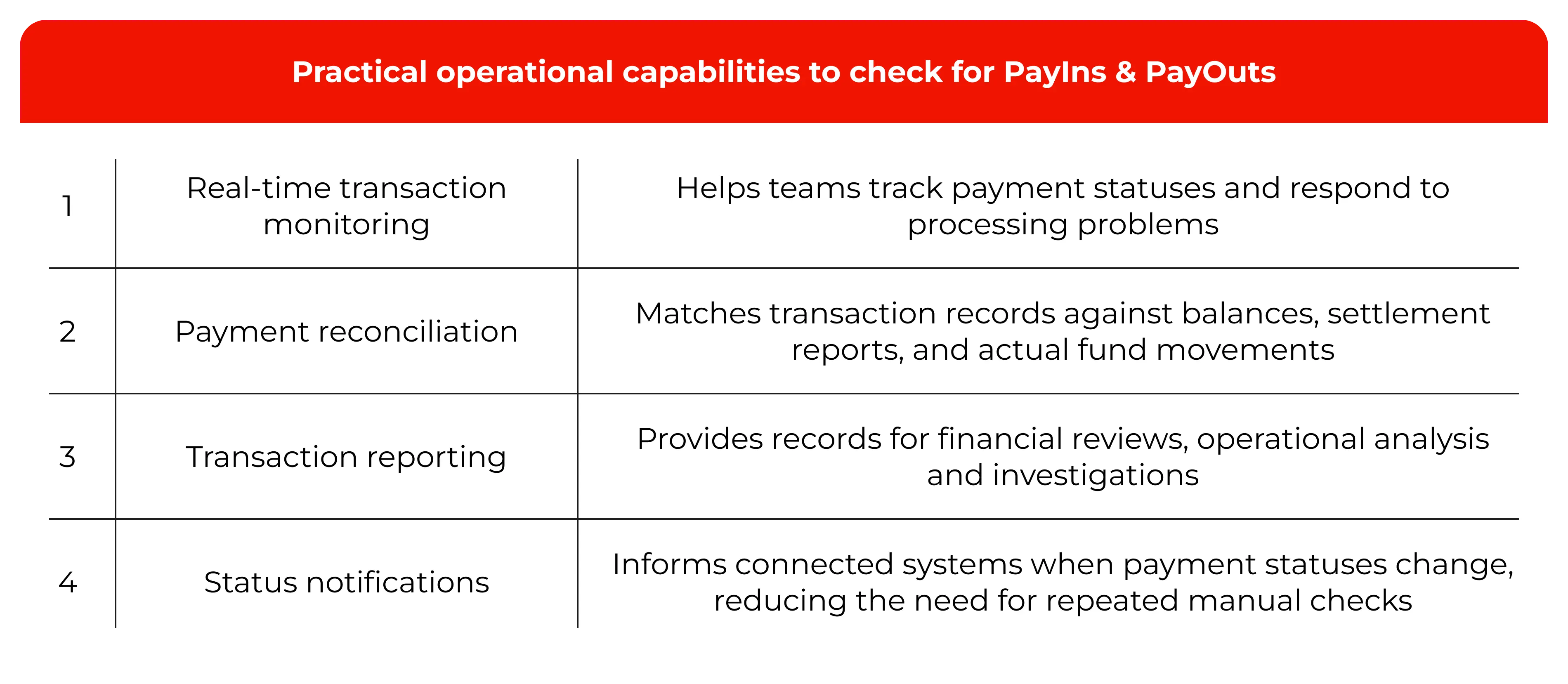
These capabilities also help businesses analyse payment performance by geography, method and transaction direction.
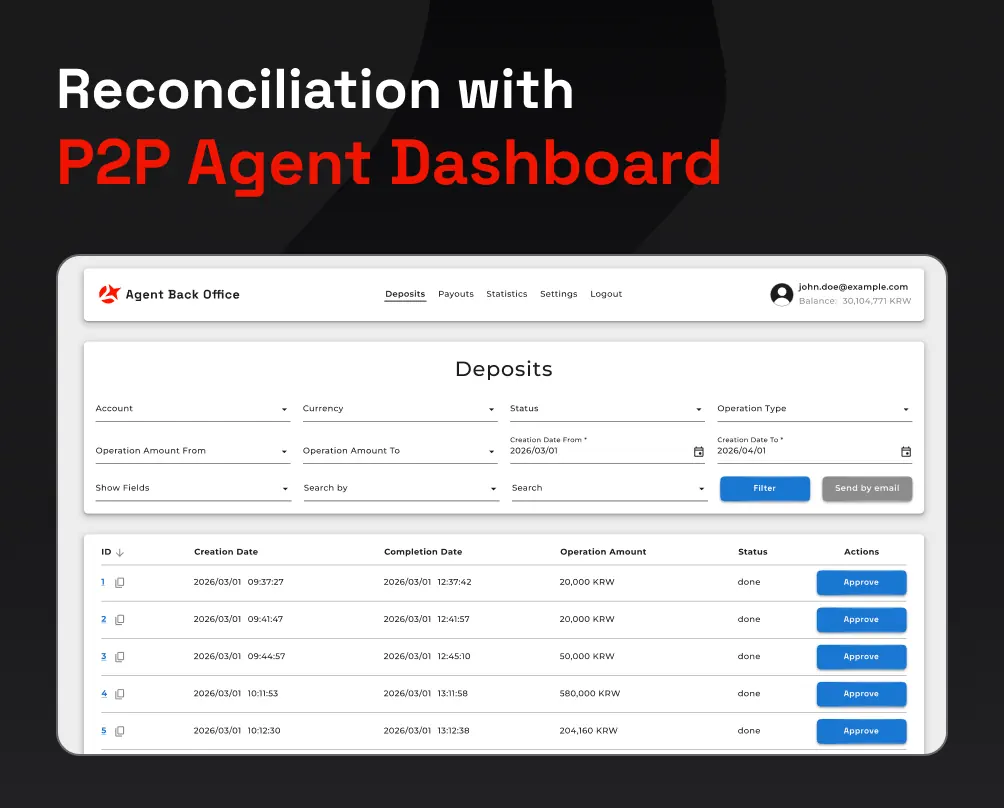
For merchants working through local P2P agent networks, visibility becomes even more important. Transactions may involve multiple agents, balances, and commission arrangements to check and permanently control. SPAYZ.io offers its partners a P2P Agent Dashboard that addresses this operational challenge by providing transaction monitoring, agent management, automated commission calculations and reporting within a single interface. Its structured transaction records and status updates help merchants manage P2P operations without relying entirely on manual spreadsheets or separate agent communications.
How to choose payment solutions for emerging markets
A provider's country coverage doesn't tell you much about how well its payment services work in practice. Before integrating, businesses should check the following.
1. PayIn and PayOut coverage
Confirm which payment methods support incoming and outgoing transactions in each target market. Country coverage alone does not guarantee that both directions are available.
2. Local payment methods
Check whether the provider supports payment options customers actually use, such as local bank transfers, mobile money and domestic eWallets.
3. Mass PayOut capabilities
Review how bulk payouts are submitted, which recipient types are supported and how individual transaction failures are handled. Check whether an API, batch processing or automated status notifications are available.
4. Settlement and currency options
Understand the settlement cycle, supported currencies, conversion terms, reserve requirements and any applicable fees. Confirm how payout liquidity is funded.
5. Transaction monitoring and reconciliation
Look for clear transaction statuses, reporting tools and records that help finance teams match payment activity against settlement amounts and account balances.
6. Compliance and operational support
Check KYC and AML requirements, beneficiary verification processes and support for the business's industry. These requirements can differ between jurisdictions and payment methods.
A provider should also be able to explain operational limits, including transaction caps, expected processing times and procedures for unsuccessful payments.
The objective is to find payment infrastructure that remains manageable as the business adds new markets and transaction volume grows.
Conclusion
Reliable payins and payouts require more than payment acceptance. Businesses expanding into emerging markets need local payment methods, predictable settlement arrangements and clear transaction visibility to keep money moving in both directions.
Looking to improve your payment operations or expand into new markets? Contact SPAYZ.io to discuss the payment methods and payout options available for your business.
PayIns & PayOuts FAQ
Can one payment API support both payins and payouts?
Yes. Some providers allow businesses to manage both directions through a single API integration. However, supported payment methods, transaction limits and payout availability still depend on the country and payment provider.
Can businesses send mass payouts to mobile money wallets?
Yes, where the provider supports the relevant local payout rails. Businesses should check recipient eligibility, wallet limits, transaction fees and verification requirements before sending payments.
How can businesses avoid duplicate or failed payouts?
Use unique transaction references, verify beneficiary details and check payment statuses before retrying. Where supported, idempotency controls can help prevent duplicate transfers when requests are repeated.
Can a business accept payments in one currency and settle in another?
Yes, some payment providers offer multi-currency settlement. Availability depends on supported currencies, local regulations and the provider's FX arrangements. Merchants should confirm conversion rates, settlement fees and timing in advance.
Which metrics matter most when monitoring business payouts?
Track payout success rates, delivery times, pending transactions, failure reasons and reconciliation accuracy. Reviewing these metrics by country and payment method helps teams identify unreliable routes and recurring operational issues.