Payment processing fees go beyond the transaction rate a payment provider quotes. Merchants may also pay for failed authorisations, withdrawals, currency conversion or settlement. These additional charges can vary by country and payment method, affecting the actual cost of processing each transaction.
For iGaming operators and Forex brokers, understanding full payment processing costs is especially important when operating across multiple markets. Card payments, eWallets, mobile money, bank transfers, and P2P transactions follow different pricing models. This guide breaks down the main fees, explains how they are calculated, and shows what merchants should check when comparing payment providers in 2026.
Key takeaways
- Card processing commonly includes interchange fees, network charges, and a provider's markup. Local payment methods don't necessarily follow the same model.
- Payin and payout can have different tariffs. Settlement terms may add costs or delay access to funds.
- High-risk payment processing fees depend on the business, its transaction history and the markets it serves. There is no reliable universal rate.
- Compare the total cost of completed payments, including charges for unsuccessful attempts, rather than choosing the lowest advertised percentage.
What are payment processing fees?
Payment processing fees are charges for accepting and processing payments. A merchant might pay a percentage of the transaction, a fixed amount or both. Other services can appear as separate line items in the contract.
Merchant fees vs merchant processing fees
Merchant fees can include account charges and other services. The term merchant processing fees usually describes the cost of individual payments.
For cards, the merchant discount rate (MDR) is the total rate charged under an acquiring agreement. The acquirer doesn't necessarily keep it all.
Transaction fees, extra charges, and surcharges
These terms often appear together in provider quotes. They aren't interchangeable.

A reserve reduces available cash while held. It isn't a permanent fee.
Who charges merchant fees and why?
The payment processing chain
A card payment involves the customer, merchant, issuer, acquirer, and network. A gateway transmits transaction details; the processor handles messages. One PSP may cover several roles.
The authorisation request moves from checkout through the processor and acquirer to the network and issuer. The response travels back. Clearing and settlement come later.
The issuer generally receives interchange. The network and provider charge for their services.
Mobile money and P2P can involve wallet operators or local agents. Their payment processing fee breakdown looks different.
What merchants actually pay for
An authorisation request uses resources even when declined. Fraud screening and payouts also carry costs.
Providers may bundle those activities or bill separately. When reviewing payment provider fees, identify what triggers each charge: an attempt, deposit, refund or outgoing transfer.
Payment processing costs breakdown
Interchange fees
The acquirer typically pays interchange to the issuer. Rates vary by card type, transaction details and jurisdiction. Domestic debit and cross-border commercial cards can be priced differently.
Card interchange doesn't apply automatically to wallets or bank transfers. A card-funded wallet may have different costs from one funded by a balance.
Assessment fees and card scheme fees
Networks charge for their services. Assessment fees often describe network charges in US pricing; card scheme fees are broader and can include several items.
A blended rate hides the breakdown; an itemised quote can show it. Neither proves which offer is cheaper.
PSP fees and payment gateway fees
A gateway transmits payment data. A processor handles processing, and an acquirer enables card acceptance. One company may provide all three.
PSP fees and payment gateway fees can include per-transaction charges or monthly minimums. A lower gateway quote may exclude services another provider bundles.
Additional costs beyond the transaction

P2P may also involve agent commission fees, defined by the agent agreement, not card schedules.
How much does payment processing actually cost?
Common payment processing pricing models
Flat-rate payment processing uses a blended rate, sometimes plus a fixed fee. Small payments suffer most from that fixed element.
With interchange-plus pricing, interchange is passed through with a disclosed margin. IC++ separates interchange, scheme charges and markup. The total varies with the card mix.
Tiered pricing groups payments by rate category. Get the assignment rules and a sample statement.
Custom High-Risk pricing can depend on volume, GEO and risk history. Don't assume one rate covers every local method.
A $100 transaction: worked example
* Illustrative figures only. These are not SPAYZ.io rates or current market quotations.

This excludes payouts, FX, and reserves. A fixed $0.10 charge equals 1% of a $10 payment but 0.1% of $100. You need to use your real ticket sizes to count.
Calculate your effective processing rate
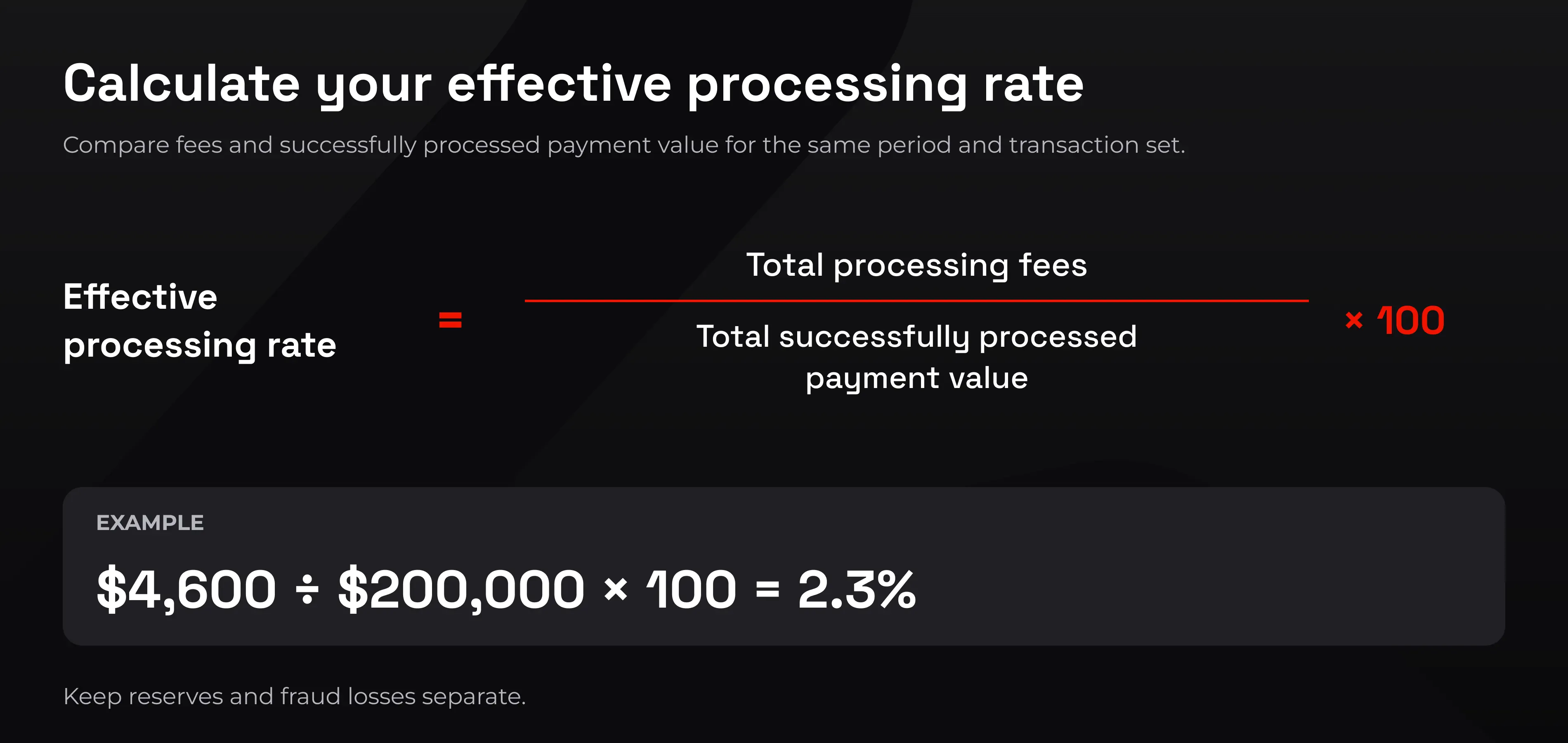
For example, a merchant processing $200,000 in successful deposits and paying $4,600 in fees has an effective rate of 2.3%. Compare matching periods and transaction sets.
Also calculate cost per successful deposit, including billed failures. Keep reserves and fraud losses separate.
Why are High-Risk payment processing fees different?
Risk, chargebacks, and additional controls
An iGaming operator with frequent disputes may get different terms from a Forex broker with a stable history, even at similar turnover. Banks and PSPs assess fraud exposure, ticket sizes and payment corridors.
Retail price lists rarely answer questions about iGaming payment processing fees or Forex broker payment processing fees. Eligibility and risk affect the offer.
Visa's Acquirer Monitoring Program (VAMP) tracks specified fraud reports and disputes for card-not-present transactions. On 1 April 2026, its excessive-merchant threshold fell to 150 basis points in Asia-Pacific, Canada, the EU, and the US. Other conditions and regional thresholds still apply. Teams need to monitor the metrics used by their acquirer.
Payin, payout, and reserves
An iGaming operator may pay a customer into a wallet; a Forex broker may settle in another currency. Payin and payout rates can differ with the same provider.
A rolling reserve limits available cash. Record it separately from fees unless withheld funds are used to settle a liability. See our guide to High-Risk settlement.
Agent-managed payments add reconciliation work when statuses differ between systems. SPAYZ.io's P2P Agent Dashboard records transactions and automatically calculates agent commissions.
Payment processing fees by country: SPAYZ.io examples
These are SPAYZ.io payment scenarios, not published tariffs.
Kenya’s case
SPAYZ.io supports M-Pesa payin and payout in Kenya. Compare both prices and the handling of failed prompts and payout limits.
SPAYZ.io's Kenya expansion case reports a 25% improvement in payment success rate across its African operations after changes to integrations and local flows. That's not a Kenya-wide benchmark or an M-Pesa fee claim. It shows why cost per completed deposit matters.
Philippines’ case
SPAYZ.io lists GCash QR and Maya payin/payout in the Philippines. A deposit rate doesn't necessarily cover withdrawals.
Take a hypothetical ₱10 fixed charge. It's 2% of ₱500 but 0.2% of ₱5,000, before any percentage fee. This isn't a SPAYZ.io tariff. Ticket size changes the economics of eWallet processing fees.
Merchant checklist: how to evaluate PSP fees in late 2026
Run each quote against one representative month of your own payments. If the provider can't give you a sample itemised statement, that's useful information too.

Payment processing fees: FAQ
Are payment processing fees negotiable?
Sometimes. Markup and service terms may be negotiable when volumes and risk are predictable. Card interchange and scheme charges follow network or regulatory rules. Ask what the provider can change.
Do merchants pay fees on failed transactions?
Yes, under some contracts. Authorisation requests can be billable when declined, and retries may count as new attempts. Check the invoice rules.
Are payout fees included in processing fees?
Not always. Withdrawals may use different rails and currencies. Request a separate PayOut schedule instead of assuming the deposit rate applies.
Is a rolling reserve an additional fee?
No. Funds are held against possible liabilities. The hold affects cash flow, but the reserve balance isn't a fee. An actual deduction to cover a charge or liability is different.
How can High-Risk businesses reduce payment processing costs?
Compare completed-payment costs using your ticket sizes, include payouts and review dispute charges. In P2P, match agent commissions to confirmed records. The monthly bill matters more than a low headline rate.
What changed in 2026, and what to expect in 2027
Where payment processing stands in late 2026
Local payment methods are becoming harder to ignore. Worldpay's Global Payments Report 2026 puts digital wallets at 56% of global e-commerce spending in 2025. That's a worldwide retail-commerce figure, not a statistic for Forex or iGaming.
A change in the wallet/card mix can change costs even at unchanged volume. Visa's 2026 VAMP threshold change also puts dispute monitoring on the agenda for card teams.
Payment processing trends to watch in 2027
More local instant-payment links are likely, including across borders. Commercial pricing will still depend on the bank, wallet or PSP. Faster settlement may improve cash flow without changing the charge for each transfer.
Expect closer scrutiny of failed-payment costs and agent reconciliation. Teams will want to see which routes complete deposits without repeated attempts and where manual checks add expense. Some providers may revise fees as fraud rules change or new payment methods reach more merchants. For now, there is no evidence that merchant fees will fall across the board in 2027.
Managing payment costs with SPAYZ.io
Across several markets, one headline rate rarely explains every deduction. Transaction records put each payment cost in context.
SPAYZ.io supports 55+ payment solutions in 35+ countries across Africa, Asia, and MENA through one API integration. Our P2P Agent Dashboard tracks agent transactions and calculates commissions, with exportable records for reconciliation.
If you're reviewing payments for an iGaming operation or Forex brokerage, contact SPAYZ.io. Share your target GEOs, expected volumes and PayIn/PayOut needs. We'll discuss available methods and the terms for your setup.