
Nigeria is one of the most important markets in Africa for merchants looking to scale, but it is also one of the hardest markets to win in payments alone. Growth in Nigeria depends less on “being present” and more on whether your payment stack feels local, reliable, and fast enough to earn trust.
For SPAYZ.io, the core lesson behind African expansion is that if users don’t trust the payment flow, the transaction will fail before the business has a chance to grow. That’s why the Nigerian market demands access to rails and payment trust built through localisation and operational control.
Real picture of Nigeria payments
Nigeria payments are shaped by convenience and habit. Merchants that want to grow here need to look beyond transaction acceptance and focus on the full payment journey, from method selection to settlement.
The Nigerian payment market doesn’t behave like a typical mobile-money-first market. Bank transfers are deeply embedded in everyday use, wallets are widely recognised, and merchants need to build trust, not just coverage.
That is why expansion into Nigeria means launching a payment method with an understanding of how users actually pay, where fraud appears, and which local rails can support conversion without creating extra friction.
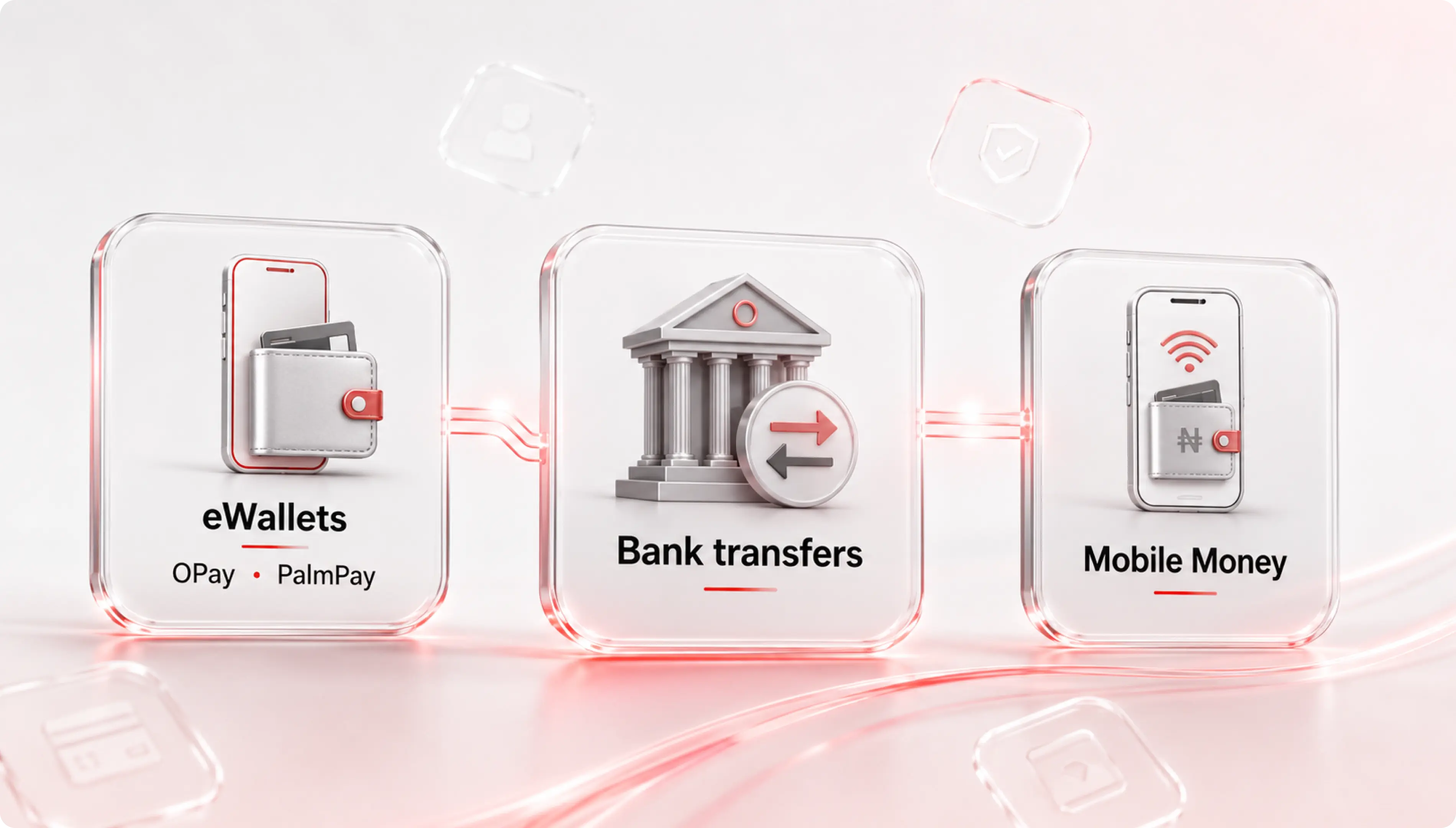
Payment methods: bank transfers, ewallets, mobile money
Bank transfers are the dominant payment method in Nigeria; there are more than 100 banks in this region. For many users, bank transfers are the default way to move money, receive funds, and complete transactions.
Ewallets that depend on Bank accounts still matter, but they are not enough on their own for broad reach. The most important problem for merchants is fraud during payin/payout. But for most merchants, this method is among the most popular.
Mobile money is prevalent across Africa, yet Nigeria is better understood as a bank transfer and wallet market than as a pure mobile money market.
This is where local payment methods become essential. If a merchant offers only a generic setup, they miss the rails users trust most and lose conversion before the transaction even begins.
Local rails
Local rails matter because they reduce the gap between what users expect and what the checkout requires. In Nigeria, that usually means support for bank transfer flows and ewallets people already recognise, especially OPay and PalmPay. They show high success rates (SRs) for Forex and are popular among users, performing better than others.
The important detail is that a payment may look simple to the user but be much more complex on the backend. A bank transfer can rely on a virtual account created for the transaction, with the account mapped to the user behind the scenes. That makes the payment experience smoother, but it also creates operational risks if the flow is not controlled properly.
User behaviour
User behaviour in Nigeria is shaped by convenience, habit, and caution. People often stick with methods they know because they feel safer than trying an unfamiliar payment method, especially if the merchant is new or the payment process is unclear.
That is why a confusing checkout can affect performance even when the underlying rail is technically available. Users don’t care how elegant the infrastructure is if the journey doesn’t feel familiar, fast, and trustworthy.
Success Rate in Nigeria: real data
For Forex businesses SPAYZ.io has an average Success Rate of 70%, while bank transfer is above 77%, and OPay is 79%. In practice, ewallets improve results by 7-10%, showing that local payment methods are not just a preference — they are a key factor in performance.
Why local payment methods affect conversion, approvals, and customer trust
Using local payment methods in Nigeria improves your payment acceptance rates — it also builds customer trust and reduces the likelihood that they will leave your payment page.
When a checkout supports the rails people already use, there is less uncertainty. The customer recognises the method, understands the flow, and is more likely to complete the payment. That matters even more in High-Risk payments, where trust is already fragile, and any extra friction can push users away.
The merchant side is just as important. If payments are not aligned with local behaviour, approval rates may fall, support tickets may rise, and customer retention may weaken. In a market like Nigeria, that is the difference between a usable payment stack and a poorly optimised one.
What improves the Success Rate in Nigeria
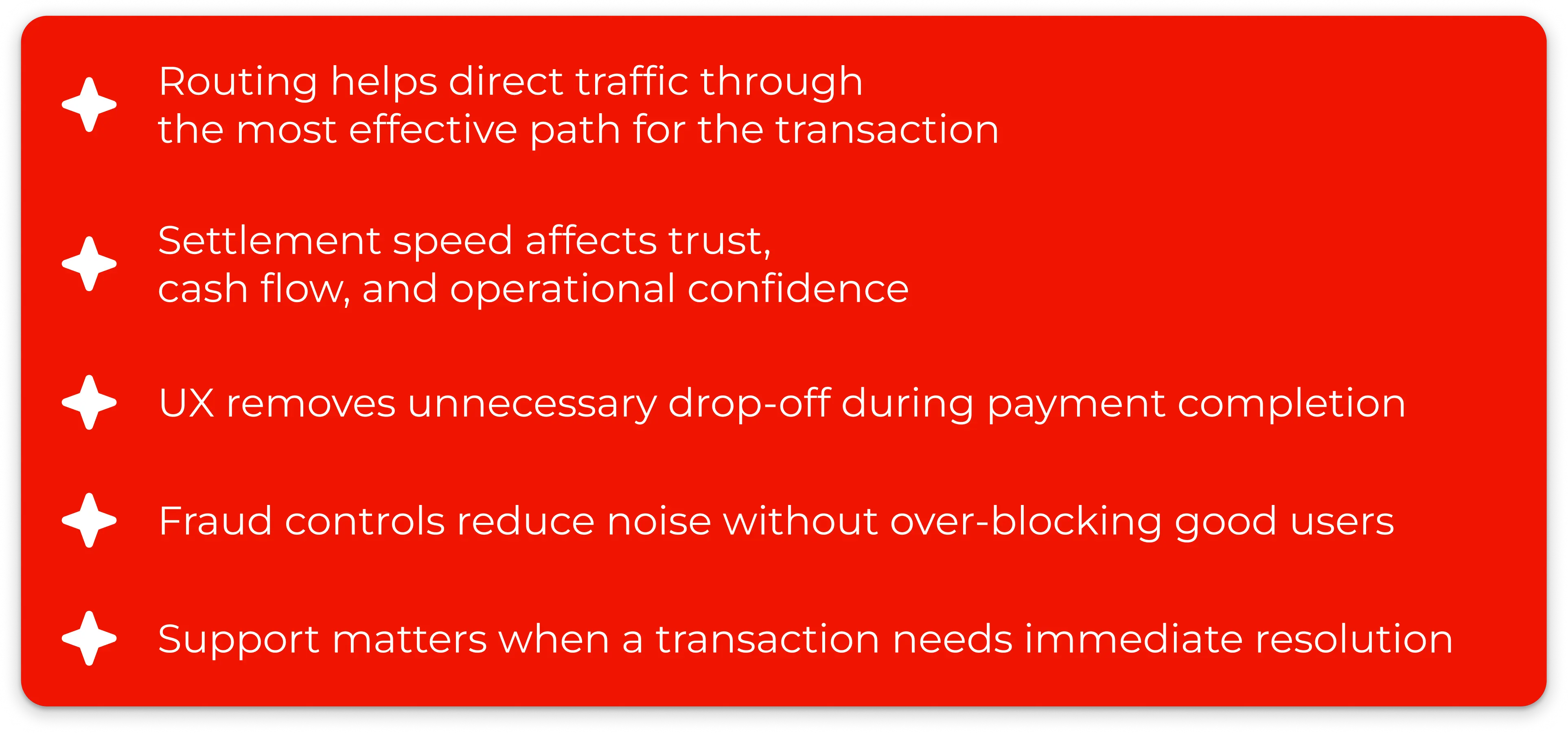
Success rate in Nigeria depends on more than just the availability of methods. The biggest drivers are routing, settlement speed, UX, fraud controls, and support.
This is especially relevant when merchants accept deposits through one account and then allow withdrawals to any destination. In that scenario, a user can input a different bank account at the payout stage, creating a third-party fraud risk.
Payout fraud in Nigeria: where the real risk appears
In Nigeria, the payment flow often looks simple on the surface, but the backend is more complex than users realise. Even when a payment is made via a straightforward bank transfer (or at least appears to be), a virtual account is usually created behind the scenes and linked to the user to process the payment.
That setup works well for deposits. The problem often appears at the withdrawal stage. If a user is allowed to enter a different bank account for payout, that opens the door to third-party fraud: someone can redirect funds from the original account to their own.
This is a real merchant risk in Nigeria, not a theoretical one. The payment layer may seem clean, but payout requires full control and approval system, with more checks than the deposit flow.
How the issue was fixed by SPAYZ.io
SPAYZ.io solved this by changing the payout logic so that withdrawals could only be returned to the user's original bank account.
The issue was that, on the deposit side, the flow worked through a virtual account created in the backend and assigned to that customer. That was fine for receiving money, but at the payout stage, it created a risk: if users were allowed to enter a different bank account, funds could be redirected to a third party.
By working with the bank and keeping the original banking data tied to the customer, SPAYZ.io removed that loophole at the time of withdrawal. This meant the payout could no longer be sent to any arbitrary account — it had to be returned to the same account used in the original banking relationship.
That closed the fraud gap, reduced the chance of third-party fraud, and made the payout flow much safer for the merchant.
What merchants should expect
Merchants expanding into Nigeria should treat payments as infrastructure, not a one-off integration.
The right setup should support:
- local payment methods
- fast settlement
- robust routing
- transparent monitoring
Especially if the business operates in High-Risk payment areas or other conversion-sensitive sectors.
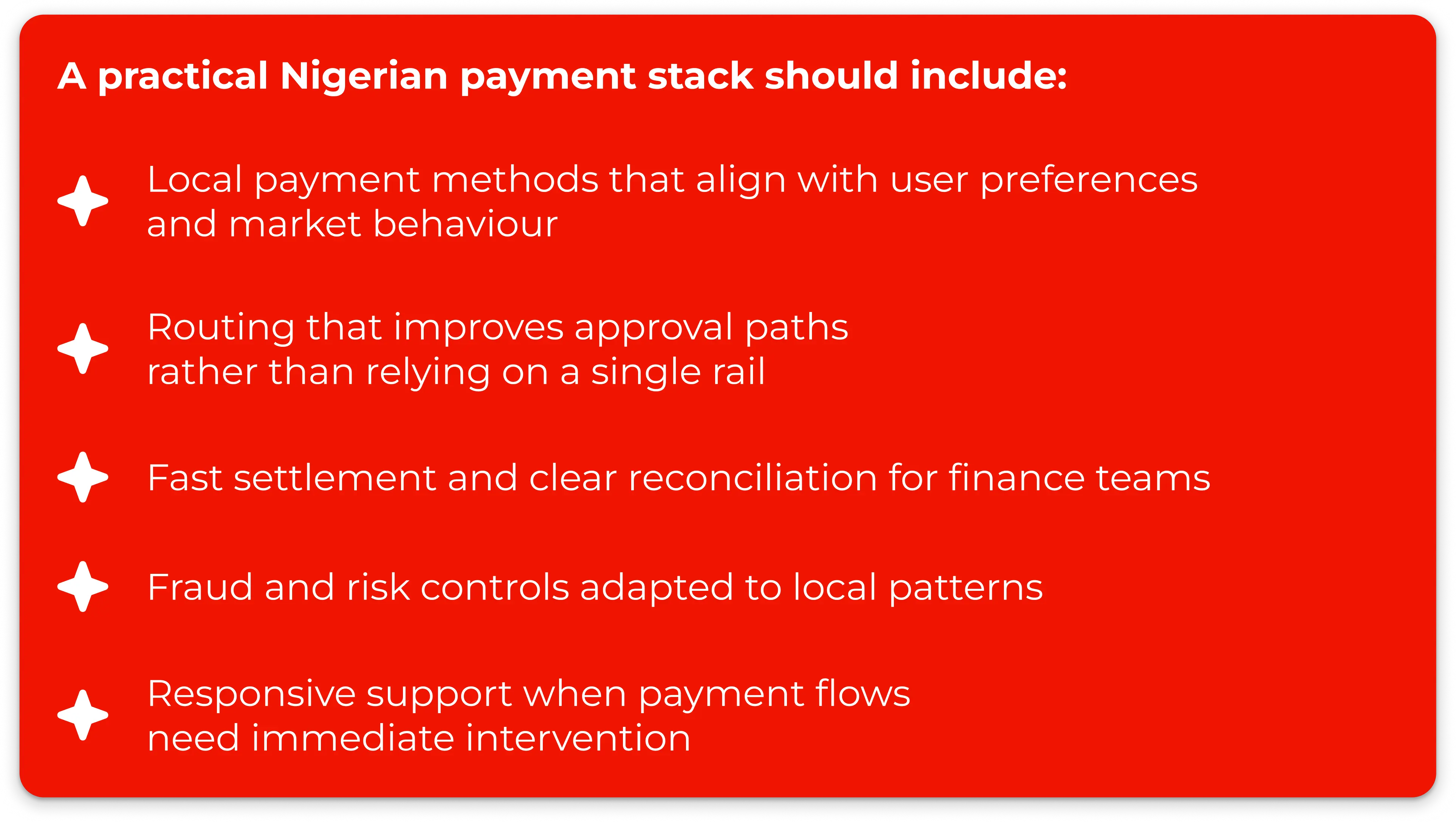
Success in Nigerian payments depends on choosing the right options and then making them work reliably every day.
Your next step to grow!
Nigeria rewards payment providers that are precise, local, and dependable. For merchants, the real opportunity is not just access to Nigerian payments, but access to a payment partner that can turn local payment methods into sustainable growth and trust.
If you’re looking for a trusted payment provider in Nigeria or are ready to expand your business, contact SPAYZ.io’s manager to choose the best solution for you.