Key takeaways
- Fraud controls operate throughout the payment lifecycle. Account checks, real-time transaction decisions, and post-payment investigations all help prevent fraud.
- Risk scores combine multiple signals. Device information, transaction velocity, customer history and payment details help assess suspicious activity. No single signal reliably proves fraud.
- Authentication needs to match the risk. Additional verification can prevent unauthorised payments, but unnecessary challenges can disrupt checkout.
- Lower fraud rates don't always indicate better performance. Approval rates, false declines, chargebacks and conversion also show whether controls are working.
- Growing businesses need more targeted controls. Different markets, payment methods and transaction volumes require segmentation, automation and regular adjustments to risk thresholds.
A stolen card can be used for a seemingly routine payment. Fraud involving a compromised customer account may be even harder to recognise, especially when the account has a history of successful transactions. Other attacks, such as card testing, leave a clearer trail of repeated authorisation attempts and declines.
Merchants need to identify these risks while processing payments, often with very little time to decide. Transaction monitoring and risk scoring can flag unusual activity, but a warning doesn't automatically mean fraud. Some payments need additional authentication, while others require further investigation or immediate blocking. Poorly configured controls can also reject legitimate transactions, affecting approval rates, conversion and customer experience.
Fraud and risk management in digital payments covers how businesses assess these risks, apply fraud detection and prevention controls, and respond when suspicious activity is confirmed. The process continues after a payment is completed, using chargebacks, fraud reports and false declines to improve future decisions. Effective payment risk management depends on understanding what happens at each stage of the transaction and adjusting controls as payment behaviour changes.
What is fraud and risk management in digital payments?
Fraud and risk management in digital payments involves identifying suspicious activity, assessing payment risks, and taking action to prevent financial losses. It includes several interconnected controls, such as transaction monitoring, verification checks, decision rules, and fraud-detection technologies.
The process starts with understanding where fraud might occur and which transactions deserve closer attention. Businesses then use payment data and risk assessment tools to decide whether to allow a transaction, require additional verification, or block it.
Payment risk management also extends beyond the transaction itself. Fraud reports, customer disputes, and chargebacks can expose weaknesses in existing controls. Teams use these findings to investigate incidents, improve fraud-prevention rules, and respond to new threats.

Fraud detection vs fraud prevention vs risk management
Fraud detection, fraud prevention, and risk management are often used interchangeably, but each plays a different role in payment security.
Fraud detection identifies activity that could indicate fraud. It analyses transactions, customer behaviour and other available data to find suspicious patterns.
Fraud prevention uses those findings to stop fraudulent activity before money is lost. Depending on the risk, the response might involve additional authentication, transaction limits, or blocking payments.
Fraud risk management covers the entire process. It defines risk policies and thresholds, coordinates monitoring and controls, manages incidents and uses investigation results to improve future decisions.

These functions depend on one another. Detection identifies possible threats, prevention determines how to respond, and risk management establishes the policies behind those decisions.
Common fraud risks in digital payments
Payment fraud can involve stolen financial information, compromised customer accounts or attempts to manipulate legitimate users. Each type produces different warning signs and can affect a business in different ways.
Card and card-not-present fraud
Card-not-present (CNP) fraud occurs when someone uses stolen card details to make an online payment without having the physical card. An unfamiliar device, an unusual transaction amount, or a payment from an unexpected location can be warning signs, especially when several indicators appear together. If the payment is authorised, the legitimate cardholder may later report the unauthorised transaction and request a chargeback. The merchant risks losing the payment amount and incurring dispute-related costs.
Card testing and automated attacks
Card testing involves fraudsters or bots submitting numerous small authorisation attempts to check whether stolen cards are active. These attacks often produce sharp increases in transaction velocity, repeated declines and unusual fraud metrics. Many attempts from related devices or IP addresses can also indicate fraud. Besides exposing businesses to fraudulent payments, automated attacks can increase processing costs and disrupt normal payment activity.
Account takeover (ATO)
Account takeover happens when a fraudster gains access to a legitimate customer account, often using stolen credentials. They may initiate payments with saved payment methods, update account details or request withdrawals. New devices, unusual login activity and sudden changes in transaction behaviour can indicate compromise. ATO is particularly difficult to identify with simple rules because the activity comes from an existing account, sometimes with a long history of legitimate payments.
Identity and synthetic identity fraud
Identity fraud involves stolen or falsified personal information used to create accounts and conduct fraudulent transactions. Synthetic identity fraud combines real and fabricated details to build a seemingly genuine customer profile. Inconsistent identity information, unusual links between accounts or suspicious registration patterns may indicate this activity. Fraudsters can use these accounts to bypass basic verification checks, build transaction history and eventually make fraudulent payments.
Phishing and social engineering
Phishing and social engineering attacks manipulate customers into revealing login credentials, sharing authentication codes or authorising payments they wouldn't otherwise approve. A fraudster might impersonate a bank or payment provider and persuade someone to confirm a transfer. Unexpected account changes or unusual payment approvals may suggest compromise. These attacks are difficult to detect when the customer completes the authentication process themselves, believing the request is genuine.
Friendly fraud and chargeback abuse
Friendly fraud, also known as first-party misuse, occurs when a legitimate cardholder disputes a payment that was actually authorised. Some cases involve deliberate chargeback abuse, while others arise from forgotten purchases or billing confusion. Repeated disputes involving transactions with valid service or purchase records can indicate misuse. For merchants, these cases increase investigation costs and may drive up dispute and chargeback rates, even when the original payments were legitimate.
Explore SPAYZ.io solutions
Managing payment operations becomes harder when a business uses multiple local payment methods across different markets.
SPAYZ.io provides payment infrastructure for High-Risk merchants in 35+ countries across Africa, Asia, and the MENA region. Businesses can access 55+ payment solutions through a single API integration.
The P2P Agent Dashboard gives merchants real-time visibility into agent transactions, with tools for reporting and operational management. SPAYZ.io also provides 24/7 support from payment specialists.
Explore the available SPAYZ.io solutions for your markets and payment requirements.
How fraud risk management works across the payment lifecycle
Fraud controls operate at different stages of the payment lifecycle. Some checks happen before a customer submits a payment, others run during authorisation, and further monitoring continues after processing.
Fraud controls and procedures vary by payment method. While 3DS and chargeback mechanisms are primarily associated with card payments, bank transfers, eWallets, and P2P payments may involve different authentication and dispute resolution processes.
Before the transaction
Pre-transaction checks help identify suspicious activity before a payment reaches the authorisation stage.
Businesses can review identity verification results, account history, device information, and past customer behaviour. Device fingerprinting can identify returning devices or possible connections between multiple accounts.
Velocity checks help when an account suddenly makes repeated payment attempts, switches between several payment methods, or shows unusual login activity.
Based on these fraud signals, pre-transaction rules may trigger verification, restrict certain actions or prevent a suspicious payment from being submitted.
During authorisation
When a payment reaches authorisation, the fraud detection system assesses the transaction using real-time information.
Transaction monitoring examines payment amount, frequency, device details, customer history and other risk signals. A rules engine, machine learning model, or combination of both can evaluate the data and assign a fraud-risk score.
The system then applies the relevant decision thresholds:
- Allow the payment to proceed when the assessed risk is acceptable.
- Authenticate the customer when additional verification is needed.
- Review an uncertain transaction, where the payment flow allows further assessment.
- Block the payment when the risk exceeds the accepted threshold.
These are fraud-screening decisions. For card payments, the issuing bank still makes the final authorisation decision.
After authorisation and settlement
Fraud can become apparent after a payment has been authorised or settled. Customers may report unauthorised activity, or a transaction may later result in a dispute or chargeback.
Post-authorisation monitoring allows businesses to review suspicious patterns that weren't apparent during processing. Investigation teams examine transaction records, customer activity and available evidence to determine what happened.

Confirmed fraud cases are then recorded and linked to the original payment decisions. This creates a feedback loop. If a particular transaction pattern repeatedly leads to fraud or chargebacks, risk teams can update the relevant rules, thresholds or detection models.

The feedback loop must account for delayed reports. Chargebacks may arrive weeks after payment processing, so businesses need to connect those outcomes with the original risk assessment.
Core components of a digital payment fraud risk framework
An effective fraud risk framework combines risk assessment, authentication, transaction monitoring, automated decision-making and investigation procedures. Each component addresses a different problem, and the system must share the results across components.
Risk assessment and risk appetite
Risk assessment identifies potential fraud threats and estimates their likelihood and financial impact.
Risk appetite defines how much exposure a business is willing to accept. For example, a merchant may approve routine payments from established customers while applying additional checks to unusually large transactions from newly created accounts.
Segmentation lets businesses set different risk thresholds for customer groups, transaction amounts, payment methods, and markets.
Clear governance is also necessary. Risk policies should specify who approves thresholds, reviews performance, and updates them as fraud patterns shift.
Identity and authentication controls
Identity verification establishes who a customer claims to be. Authentication checks whether the person accessing an account or initiating a payment is authorised to do so.
Common controls include multi-factor authentication (MFA), 3-D Secure (3DS) for eligible card transactions, device recognition and step-up authentication.
Device signals can also reveal unusual access patterns, particularly when an account is used from an unfamiliar device shortly before a payment.
These checks reduce certain fraud risks, although successful authentication doesn't guarantee that a payment is legitimate. A customer may still have been manipulated into approving a fraudulent transaction.
Real-time transaction monitoring
Real-time transaction monitoring examines payment activity as it happens. Instead of reviewing transactions only after processing, businesses can identify suspicious patterns while they still have a chance to intervene.
Monitoring systems can detect repeated payment failures, sudden increases in transaction frequency, unusual payment amounts or activity that differs from a customer's established behaviour.
For example, an account that normally makes occasional small payments may suddenly attempt several large transactions within minutes.
The system can flag this change for additional checks. Whether the system can stop the payment immediately depends on the processing flow and available controls.
Risk scoring and decision rules
A fraud risk score estimates how likely a transaction is to be fraudulent using multiple data points.
The scoring system may examine transaction amount, device information, location, account history and previous payment behaviour. Decision rules then compare the result against predefined thresholds.
Low-risk payments can proceed automatically. Transactions with elevated risk may require authentication or further review. Payments that exceed the accepted risk threshold can be blocked.
Risk teams need to review these thresholds regularly. If a rule rejects many legitimate transactions without preventing much fraud, its settings may be too restrictive.
Rules-based detection and machine learning
Rules-based fraud detection uses predefined conditions to identify known patterns.
For example, a rule might flag multiple payment attempts from one device within a short period or reject transactions linked to previously confirmed fraud.
Machine learning can examine more complex relationships between signals and identify patterns that are harder to describe through fixed rules. It can also adapt to changing behaviour when models are updated with suitable data.
Both approaches have limitations. Fixed rules require maintenance, while machine learning depends on training data quality and ongoing validation.
Combining rules with machine learning allows businesses to apply clear controls to known threats while assessing less obvious fraud patterns.
Investigation and manual review
Some transactions don't provide enough evidence for a confident automated decision. These are the cases where manual review is most useful.
A fraud analyst may examine account activity, device history, previous transactions or supporting documents before deciding whether to approve, reject or escalate a case.
Limit manual review to situations where human assessment is likely to add useful information. Sending too many transactions for investigation increases costs and slows processing.
Some payment methods also require an immediate decision, so businesses must complete additional checks before authorisation rather than delay the payment itself.
Reporting, analytics, and feedback loops
Fraud reporting links payment-processing decisions to their eventual outcomes.
Businesses need to track confirmed fraud, chargebacks, false positives, approval rates, and manual review results. These metrics show whether controls stop suspicious activity or unnecessarily restrict legitimate payments.
For example, if a particular rule blocks a large number of transactions but rarely identifies confirmed fraud, the threshold may need adjusting.
Analytics also enable comparisons across customer segments, markets, and payment methods.
Investigation findings and reporting data should feed back into the rules engine and machine learning models, giving risk teams a basis for future changes.
Real-time risk scoring: which signals matter?
Real-time risk scoring combines transaction information with customer, device and behavioural data to estimate fraud risk.
The system assesses several risk signals rather than relying on one unusual detail. For example, a high-value payment may be normal for one customer but unexpected for another.

A single signal rarely proves fraud. Customers travel, replace devices and sometimes make payments that differ from their usual spending.
Risk scoring becomes more useful when the system evaluates these details together. A new device might not be concerning on its own, but a new device combined with recent password changes and several high-value payment attempts deserves closer attention.
The combined fraud risk score is compared with defined thresholds to determine whether the transaction should proceed, require authentication, be reviewed or be blocked.
Those thresholds need testing against actual fraud outcomes and false positives. Otherwise, the scoring system can become either too permissive or unnecessarily restrictive.
How authentication helps reduce payment fraud
Payment authentication checks whether the person initiating a transaction is authorised to make it. It is one of the controls businesses use to reduce unauthorised payments, particularly when stolen credentials or compromised accounts are involved.

Different authentication methods serve different purposes.
3-D Secure (3DS) is an authentication protocol for online card payments. It enables information exchange between merchants, payment networks and card issuers to support the issuer's authentication decision.
Under EMV 3DS, authentication can follow a frictionless flow, where the customer doesn't need to complete an additional step, or a challenge flow that requires further verification.
Multi-factor authentication (MFA) uses two or more authentication factors, such as a password and a registered device or biometric verification. It provides additional protection against unauthorised access to accounts.
Step-up authentication introduces stronger verification when the system identifies elevated risk. For example, a customer who normally uses a recognised device may need to complete an additional check after logging in from a new one.
Risk-based authentication uses available transaction and customer information to determine when additional checks are appropriate.
Authentication decision model
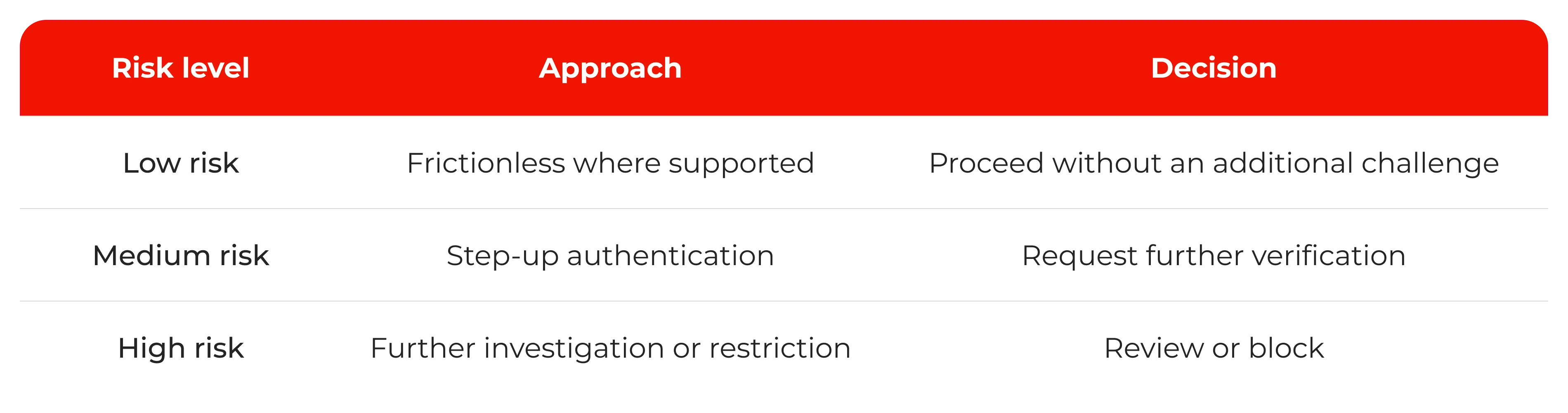
This table illustrates a general risk-based decision process. Actual 3DS authentication flows depend on issuer decisions and the relevant payment requirements.
Authentication helps prevent fraud, but additional checks also create customer friction. Repeated verification requests can delay checkout or cause customers to abandon legitimate payments.
Risk-based authentication limits unnecessary challenges by applying stronger checks when available signals indicate a genuine need.
Balancing fraud prevention with approval rates and customer experience
Fraud controls can reduce unauthorised transactions, but strict rules can also reject legitimate payments.
A false positive occurs when the system incorrectly flags genuine activity as suspicious. If that decision results in a rejected payment, it becomes a false decline.
For merchants, false declines mean lost payment opportunities. Customers may abandon checkout rather than retry a rejected transaction or complete additional verification.
The effect is particularly noticeable when risk rules rely on isolated signals. For example, blocking every payment from an unfamiliar device would also affect customers who recently replaced their phones.
Risk scoring adds context to each decision by combining several signals. Segmentation lets businesses apply different thresholds based on customer history, payment method, or transaction profile.
Step-up authentication can also offer an alternative to immediate rejection. Where supported, customers with moderately elevated risk can complete another verification step instead of having their payment blocked.
Payment teams should distinguish fraud-related declines from issuer rejections, insufficient funds and technical failures. Otherwise, changes to fraud controls may have little effect on the actual cause of failed payments.

This balance matters most in iGaming, where customers expect deposits to go through without unnecessary delays. False declines can interrupt account funding and reduce payment conversion. Operators comparing iGaming payment solutions should consider how fraud checks affect both payment security and the legitimate player experience.
How to measure fraud and risk management performance
Fraud rate alone doesn't show whether a fraud management system is performing well.
A business might reduce fraud losses by rejecting more payments, but that approach can also increase false declines and reduce conversion. Assess the financial impact across several metrics.

These figures need consistent definitions. Chargeback rate calculations can differ between payment networks, while false-decline rates are difficult to measure precisely because rejected payments don't always have a confirmed final outcome.
Performance also needs to be assessed over time.
If fraud losses decrease while approval rates and conversion remain stable, the controls may be improving. If legitimate customers face more declines without a meaningful reduction in fraud, risk teams should investigate the rules responsible.
Comparing results across payment methods, customer segments, and markets can reveal problems that overall performance figures hide.
How fraud risk management changes at scale
Fraud management becomes more demanding as transaction volume grows.
A business handling relatively few payments can manually investigate most suspicious transactions. At higher volumes, the same process becomes expensive and can delay payment decisions.
Expansion into new geographies adds further complexity. Customers use different payment methods, transaction values vary between markets, and normal payment behaviour isn't identical everywhere.
For example, frequent small payments may be typical for certain mobile wallet users but unusual for customers using other payment methods. Applying the same velocity threshold to both groups could create unnecessary alerts.
Fraud risk management at scale requires more automation and detailed segmentation.
Automated controls handle routine checks and straightforward risk decisions. Segmentation lets fraud teams adapt thresholds to specific customer groups, payment methods, and markets.
Threshold tuning remains necessary as transaction patterns change. Continuous monitoring and feedback loops help teams identify where fraud detection needs improvement or where existing rules cause false positives.
Manual review still matters for complex investigations, but businesses can't indefinitely increase analyst capacity to match transaction growth. Better automated decision-making allows teams to focus on cases that genuinely need human attention.
What to look for in a payment provider's fraud and risk controls
Payment providers offer different levels of fraud protection, monitoring, and risk-management support.
Before selecting a payment service provider (PSP), merchants should determine which controls are included, what requires additional integration, and who makes transaction decisions.
Payment provider evaluation checklist

Merchants should also ask how the provider handles false positives and rejected transactions. Access to decline reasons, investigation records and transaction history makes it easier to understand whether a payment failed because of fraud controls or another processing issue.
Responsibilities vary by provider and payment method. A PSP may offer fraud screening and transaction monitoring, while a card issuer retains responsibility for the final authorisation decision. Other payment methods use different verification and dispute procedures.
The choice of provider should reflect the merchant's payment volumes, target markets, accepted risk levels and need for transaction visibility.
If you’re looking for a provider now or have any questions about fraud defence, contact SPAYZ.io team to explore opportunities for your business.
FAQ about about fraud risk management in digital payments
What are the main fraud risks associated with digital payments?
The main digital payment risks include card-not-present fraud, account takeover, identity fraud, phishing and chargeback abuse. Fraudsters may use stolen payment details, access legitimate customer accounts or manipulate users into approving transactions. These attacks can cause financial losses, higher dispute rates, and additional investigation costs. Businesses also risk rejecting genuine payments when fraud controls are too strict, which can lower approval rates and harm the customer experience.
What is the difference between fraud detection and fraud prevention?
Fraud detection identifies suspicious transactions or customer behaviour through monitoring, risk scoring and pattern analysis. Fraud prevention uses those findings to reduce the likelihood of fraudulent activity and minimise potential financial losses. For example, detection might flag repeated payment attempts from one device, while prevention blocks further attempts or requests verification. Fraud risk management covers both functions, along with risk policies, incident response and reviews of how well existing controls perform.
How does real-time fraud detection work in digital payments?
Real-time fraud detection examines payment information while a transaction is being processed. Monitoring systems analyse signals such as transaction amount, device, location, account history and payment frequency. Rules or machine learning models use these signals to assess risk and may produce a fraud risk score. Depending on the result and the available payment flow, the system can allow the payment, request authentication, refer it for review or block it.
What is a fraud risk score?
A fraud risk score estimates how likely a transaction is to be fraudulent. It combines risk signals such as payment amount, transaction velocity, device information and customer history. The system compares the result against predefined thresholds to determine whether to proceed with the payment, require review, or block it. Some systems also use the score to trigger additional authentication. A risk score supports payment decisions, but it doesn't prove that a transaction is fraudulent.
Can fraud controls reduce payment approval rates?
Yes. Fraud controls can lower approval rates when they incorrectly reject legitimate payments. These false declines often result from overly strict rules, unsuitable thresholds or incomplete customer information. Additional authentication may also interrupt checkout and reduce conversion. Risk-based controls help merchants apply stronger checks where risk is higher while letting routine transactions proceed with fewer interruptions. Assess fraud losses, approval rates, and customer experience together.