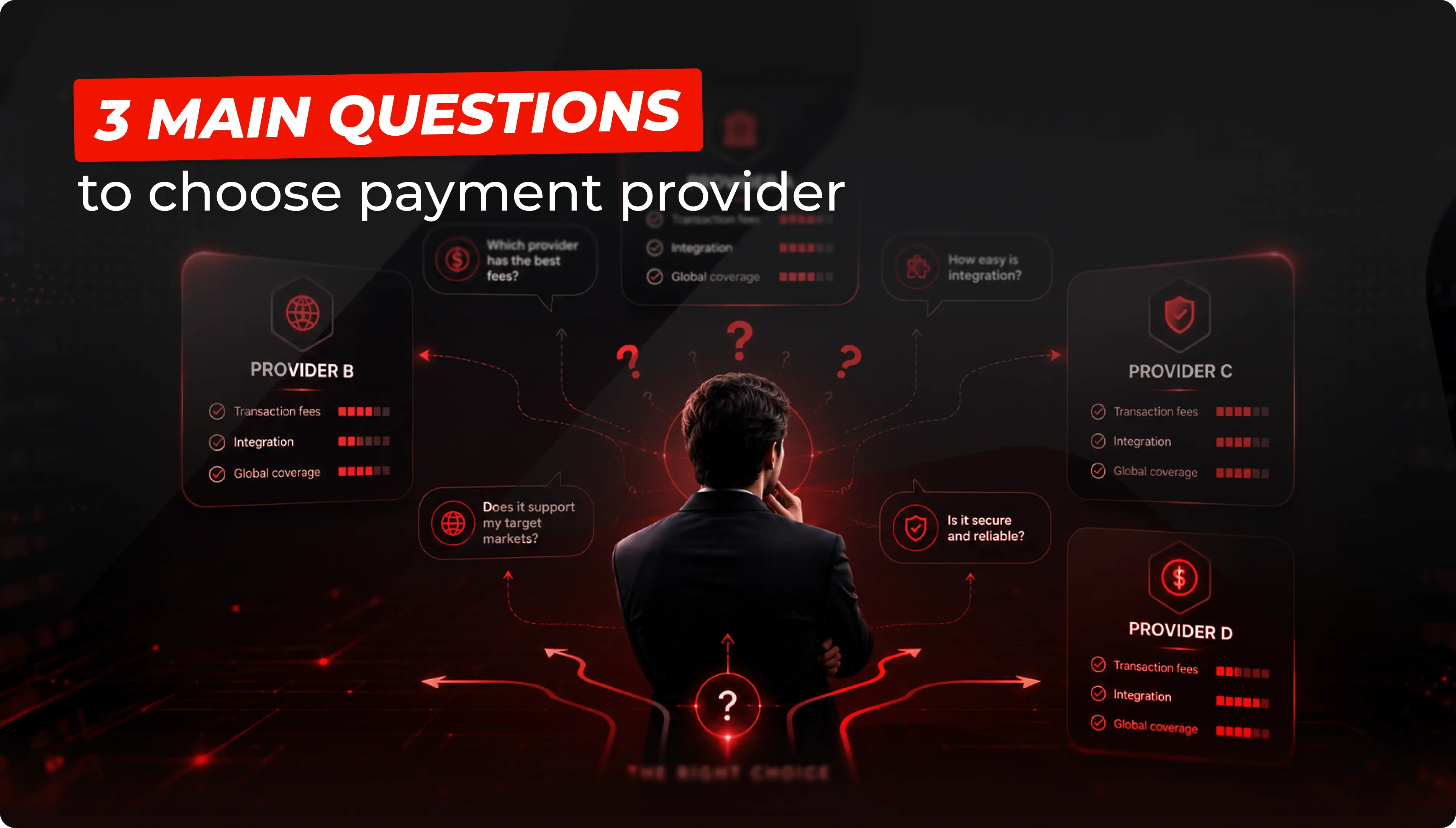
Most payment providers look convincing during the sales process. The pricing looks competitive, and integration seems straightforward. Every provider claims to support the payment methods you need. The real differences only become obvious once transactions start coming through. That's when issues start to surface: delayed settlements, unstable acquiring, limited local payment coverage, or slow support.
That's why due diligence matters. Before signing a contract, look beyond licences and processing fees. These are the three areas worth checking when choosing a trusted payment provider.
Criteria 1. Licence and regulations: how to check
Most merchants start with the licence. A licence tells you that a regulator has approved the company to provide certain payment services. It doesn't tell you whether that provider is the right fit for your business. It also doesn't tell you how the provider performs day-to-day. A licence won't tell you how stable the acquiring network is, how quickly settlements arrive, or how problems are handled. That's why payment provider reliability depends on much more than regulatory approval.
What is important to know when asking about licence and regulations:

A provider may legally process payments in one region while depending entirely on external partners elsewhere. If an acquiring partner changes its risk policy or leaves the market, your payment setup may need to change with it.
Compliance is another area worth checking. A trusted payment provider should be able to explain its approach to PCI DSS, KYC/KYB, and AML without giving vague sales answers. The same applies to documentation. You shouldn't have to chase basic compliance documents or sign an NDA just to confirm they exist.
High-risk businesses can't afford to rely on logos and licence badges. The providers worth working with are usually the ones willing to explain exactly how they operate.
Short checklist before signing
Before moving forward, make sure the provider can answer these questions clearly, but with specific details.
You should know:
- Which regulator oversees your business?
- How often do you complete compliance audits?
- Which PCI DSS certification level do you maintain?
- How do you handle AML, KYC and KYB checks?
- Which documents will you need during merchant onboarding?
- Do your compliance requirements vary by country or payment method?
Criteria 2. Local payment methods: the quality is better than quantity
You'll see claims such as "500+ payment methods" and "global payment coverage" on almost every payment provider's website. They sound impressive, but they say very little about how payments are processed in practice.
Offering a payment method doesn't necessarily mean it performs well. Two providers may support the same local payment methods, yet deliver very different payment experiences. One may connect directly to local banks and payment networks, while the other depends on third-party partners. The checkout may look identical, but the way those payments are processed can be very different.

This matters even more when expanding into new markets. Across Africa, Asia, and MENA, local payment methods often influence conversion rates more than international card schemes. A trusted payment provider should know which payment methods customers actually use in each market and explain why those options are the right fit for your business. This directly affects how your business grows in the GEO you have now and how it can expand in the future.
Short checklist to ask about integration
Before committing to a payment provider, make sure the integration process is as straightforward as promised.
Ask questions such as:
- How long does a typical integration take?
- Can we access the sandbox before signing a contract?
- Do you provide a single API or separate integrations for different payment methods?
- Is your technical documentation publicly available and regularly updated?
- What technical support is available during implementation?
Criteria 3. Support: how problems are solved by the provider
You find out how reliable a payment provider really is when payments start failing, settlements are delayed, or an acquiring partner changes its risk policy without warning. That’s nothing unusual about that, particularly for merchants operating in emerging markets, but the real difference lies in how quickly your payment partner responds and what it can do to find a solution.
There are some frequent issues that could happen in payment processes:
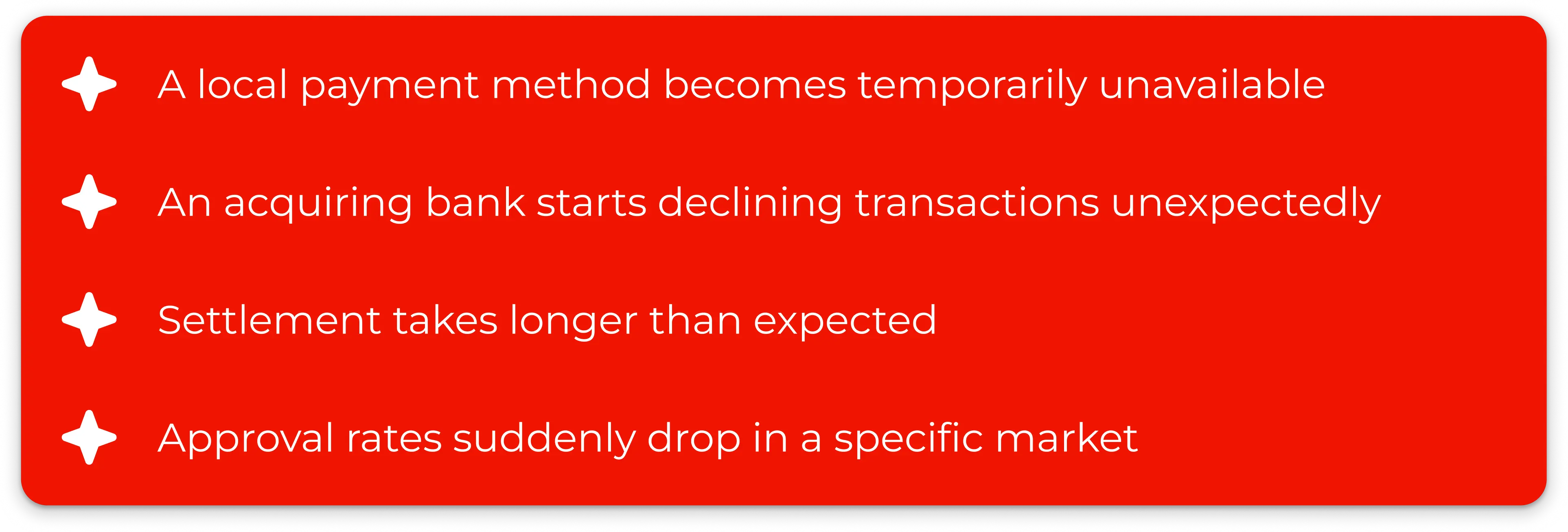
A quick response is important, but it isn't enough. A trusted payment provider should have clear escalation procedures, experienced payment specialists and direct access to technical experts who can resolve operational issues before they affect your business.
Short checklist for support learning
Clear escalation procedures and experienced payment specialists are key indicators of payment provider reliability.
It’s better to know before starting collaboration:
- Who handles critical payment incidents?
- Is operational support available 24/7?
- How are merchants informed about outages or processing issues?
- Can payment traffic be rerouted if an acquiring partner becomes unavailable?
- Who investigates sudden increases in declined transactions or suspected fraud?
- How are critical issues escalated, and who is responsible for resolving them?
Making a better payment provider decision
Before signing with a payment provider, ask the same questions you would ask any long-term business partner. Start with regulatory compliance and licences, but don't stop there. Review the provider's payment infrastructure: APMs & LPMs controls, settlement processes, acquiring network, security standards, operational support. A trustworthy payment provider should be transparent about all of these.
By the time payment processing is live, changing providers becomes much more complicated. It's worth asking the difficult questions before the contract is signed.
At SPAYZ.io, we encourage merchants to ask those questions. Whether you're entering a new market or reviewing your existing payment setup, our team will explain how our payment infrastructure, local acquiring network, and operational processes work before integration begins and help you choose the right solution for your business. Ready to ask questions? Contact the SPAYZ.io manager right now.