
Affiliate marketing helps FinTech platforms reach customers through publishers, comparison sites, creators, and other partners. But clicks and registrations don't show whether a programme actually works. The metrics that matter sit further down the funnel: verified accounts, first successful payments, active users, and the revenue they generate. This is particularly true in High-Risk sectors like iGaming and Forex, where payment availability, local habits, and regulation can kill conversion after the affiliate has done its job.
A strong programme connects affiliate data with the rest of the customer journey, from verification to the first successful payment. This helps teams see which partners and GEOs bring valuable customers, where conversion drops, and whether the issue sits with acquisition, the product or the payment flow.
Why affiliate marketing works differently in FinTech
Affiliate programmes can pay for clicks, leads, approved accounts, first deposits or revenue from referred customers. The right model depends on the product and what the business counts as a valuable conversion. That distinction matters in FinTech because registration is often just an early step.
A referred user might create an account and stop during verification.
Another might complete onboarding but never make a payment.
Someone else may try to deposit and fail because the available payment method doesn't work for them.
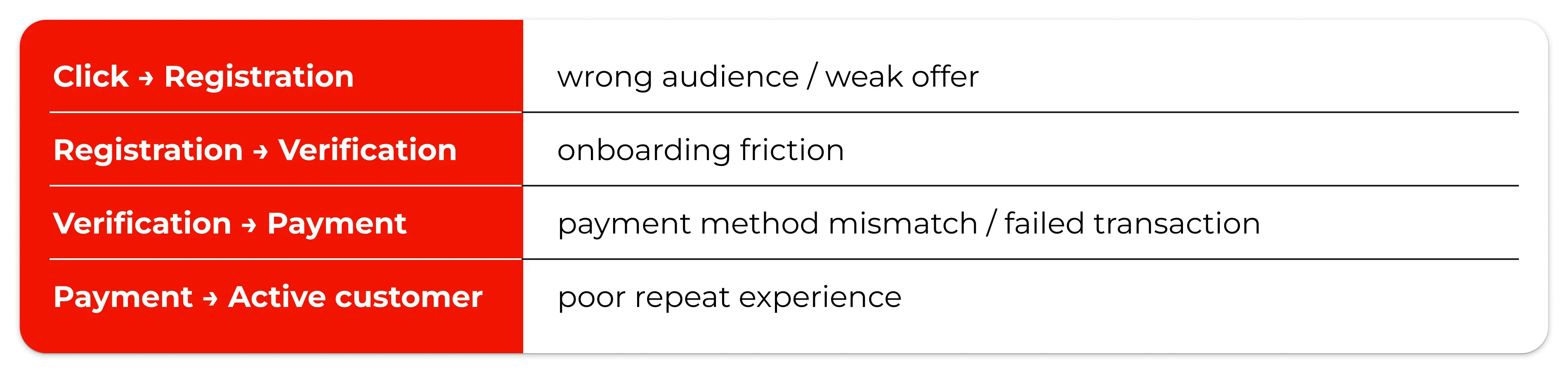
Every stage changes how you should evaluate the original affiliate traffic.
If one partner generates 500 registrations and 80 funded accounts while another generates 300 registrations and 150 funded accounts, then registration volume alone doesn't show their value.
In FinTech marketing, this changes the question. Instead of asking which affiliate brings the most traffic, teams need to know which affiliates bring customers who complete the actions that matter to the business.
Where affiliate networks fit into customer acquisition
Affiliate networks give FinTech companies access to publishers and other partners without building every relationship from scratch. Depending on the product and market, those partners might include specialist finance websites, comparison services, regional publishers, review sites, creators or independent affiliates.
But joining a network doesn't create an affiliate strategy on its own. The company still needs to decide what counts as a conversion, how referrals are attributed and which GEOs each partner can target. It also needs clear rules around promotional claims and a way to measure what happens after registration.
An affiliate dashboard might show that a partner sent 3,000 visitors and generated 250 registrations. Those numbers tell the acquisition team whether the partner can attract attention and whether the landing page converts that traffic into sign-ups.
They don't tell the team whether those users became customers.
For financial products, useful attribution often needs to continue beyond the initial lead. Finance-focused affiliate platforms increasingly connect referral data with later events such as approved or funded accounts. Fintel Connect, for example, includes full-funnel tracking and compliance monitoring in its description of affiliate software for financial services. As a vendor, it isn't an independent benchmark, but these features reflect the additional tracking requirements financial companies have compared with a simple retail affiliate programme.
The rule is simple: measure partners against the event that matters to the business.
Five ways to build a better FinTech affiliate programme
1. Choose affiliates for their audience, not their size
Large publishers can send large amounts of traffic. That doesn't automatically make them the right partners. Audience fit matters more.
A Forex platform targeting Southeast Asia, for example, may get better results from a smaller regional publisher than from a major European finance website. The regional partner may already reach people who trade, use relevant financial products and recognise the platform's payment options.
Before bringing a new affiliate into the programme, look at where its users come from and what products it already promotes. Traffic history can also show whether the audience matches the customers the platform wants to acquire.
This gives the team something better than a publisher's total reach: an idea of whether its audience is likely to convert.
2. Define what a conversion actually means
The commercial model should follow the result the business needs.
For some platforms, a verified account is enough. Others care about the first successful deposit. Revenue-share programmes link partner earnings to referred customers' activity over time.
Problems start when the affiliate KPI stops too early. Suppose two partners each generate 500 registrations. Partner A produces 80 first deposits. Partner B produces 210.
If the report ends at registration, they look equally effective. If the business earns money after a customer funds an account, they clearly aren't.
That doesn't mean every programme should pay affiliates for the same event. It means the company should know how the event it pays for relates to the result it actually needs.
3. Plan campaigns by GEO
Affiliate performance can change sharply between countries, even when the product and commercial offer stay the same.
A campaign in Kenya should reflect how Kenyan customers pay and which local channels they already trust. The same applies to Indonesia, Pakistan or another target market. Affiliate selection, landing pages, and payment options all need to make sense for the people the campaign brings in.
This matters especially for FinTech platforms marketing across several countries. One global conversion rate can hide strong performance in one market and a clear problem in another.
4. Connect affiliate results with payment performance
Affiliate reporting usually answers the first part of the acquisition question: where did the customer come from? Payment data helps answer what happened next.
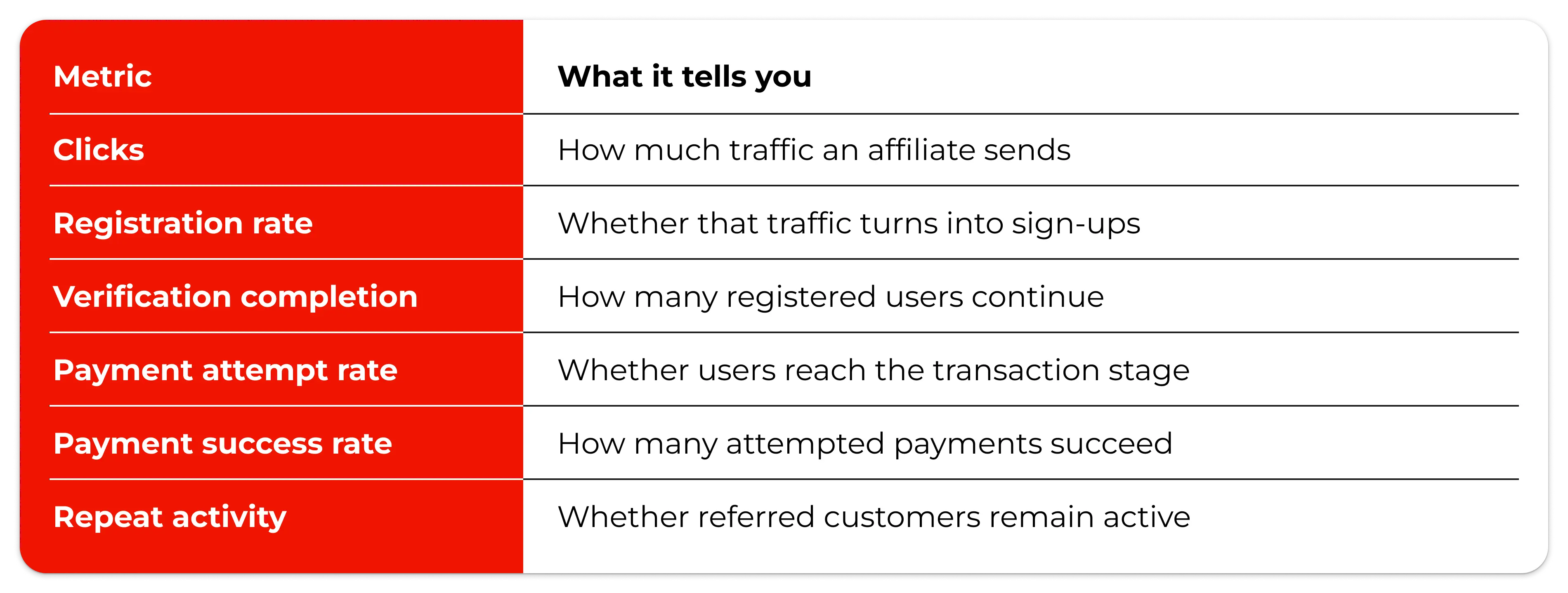
If an affiliate generates plenty of registrations but few users attempt a payment, the issue likely occurs before the transaction stage. The offer may be attracting the wrong audience, or users may be dropping out during onboarding.
If users reach the payment stage but transactions fail, changing the affiliate campaign may do very little. The team needs to look at the payment setup instead.
For the marketing team, the goal isn't to diagnose payment infrastructure itself. It is to know when a weak campaign result is actually a payment problem.
5. Keep affiliate compliance under the company's control
Affiliates are external partners, but companies can't assume that this removes responsibility for what those partners publish.
The UK's Financial Conduct Authority says firms should take proactive responsibility for how affiliate marketers communicate financial promotions. Its guidance also explains that a firm may still be causing a financial promotion to be communicated where an affiliate creates the content and includes the firm's referral link.
The US Federal Trade Commission takes a similar position on disclosure. It says affiliate relationships should be disclosed clearly and conspicuously, and that simply writing "affiliate link" may not always explain the commercial relationship clearly enough to consumers.
Requirements vary by jurisdiction and product, so no single compliance checklist works everywhere.
But the company should still set the rules for its programme. Affiliates need to know which claims they can make, what materials they can use, where disclosure is required and which markets they are allowed to target. Their content also needs to be reviewed after onboarding, not only when the partnership starts.
For affiliate marketing for financial services, compliance is part of partner management rather than a final check before a campaign goes live.
What happens after the affiliate sends the customer?
Affiliate teams can change partners, offers, landing pages and commission models. They can't solve every reason a customer fails to convert. At some point, the product takes over.
Consider a user who arrives through an affiliate, registers and decides to make a deposit. Acquisition did its job. Then the user discovers that their preferred local payment method isn't available. Or the transaction fails. Or the payment flow asks them to use a method they don't normally use.
The business got the traffic but lost the transaction.
This is why payment conversion belongs in acquisition reporting. It doesn't mean marketing teams should start managing gateways or payment routing. They simply need enough data to see whether the traffic they acquire can complete the process.
Payment method coverage alone doesn't answer that question either. A method can exist on the platform but still perform badly if the payment process is unfamiliar or requires too many steps. SPAYZ.io's 2026 payment research notes that friction-heavy payment flows can lose relevance even when the underlying method remains available.
To the customer, affiliate acquisition, registration, and payment aren't separate departments. They are one continuous experience with the platform.
That makes the handover between marketing and payments commercially important.
Affiliate marketing in High-Risk sectors
The connection becomes more visible with affiliate marketing in High-Risk sectors such as iGaming and Forex.
These businesses often depend heavily on affiliate acquisition while operating in markets where payments can be harder to manage. Some mainstream providers don't support High-Risk verticals. Local payment preferences differ between countries. Merchants may also need additional transaction monitoring and market-specific payment connections.
As a result, strong top-of-funnel affiliate performance doesn't guarantee revenue.
Imagine a Forex affiliate bringing relevant users from a target country. They click, register and reach the deposit stage. If the payment setup doesn't match the market, spending more on that affiliate won't improve the conversion rate. It just sends more people to the same point where existing users are already dropping out.
Low registration rates may point to the campaign or landing page. Strong registrations followed by poor verification rates call for a different investigation. And if verified users consistently reach the payment stage but fail there, the payment flow is the problem.
Breaking performance down by affiliate and GEO makes these differences easier to see.
It also gives High-Risk marketing teams a better basis for deciding where to spend more and where to fix the existing funnel first.
Marketing teams shouldn't have to manage payment infrastructure
Affiliate and marketing teams need enough information to understand why referred customers stop converting. They don't need to manage separate payment integrations, maintain local connections or investigate routing themselves.
That work belongs with payment and operations teams and their payment provider. For an acquisition team, the benefit is practical. The team can focus on affiliates, campaigns, and customer acquisition instead of treating payment operations as another marketing task.
But the connection between the two still matters. If marketing knows which traffic converts and payment teams know where transactions fail, the business can make better decisions about both acquisition spend and payment coverage.
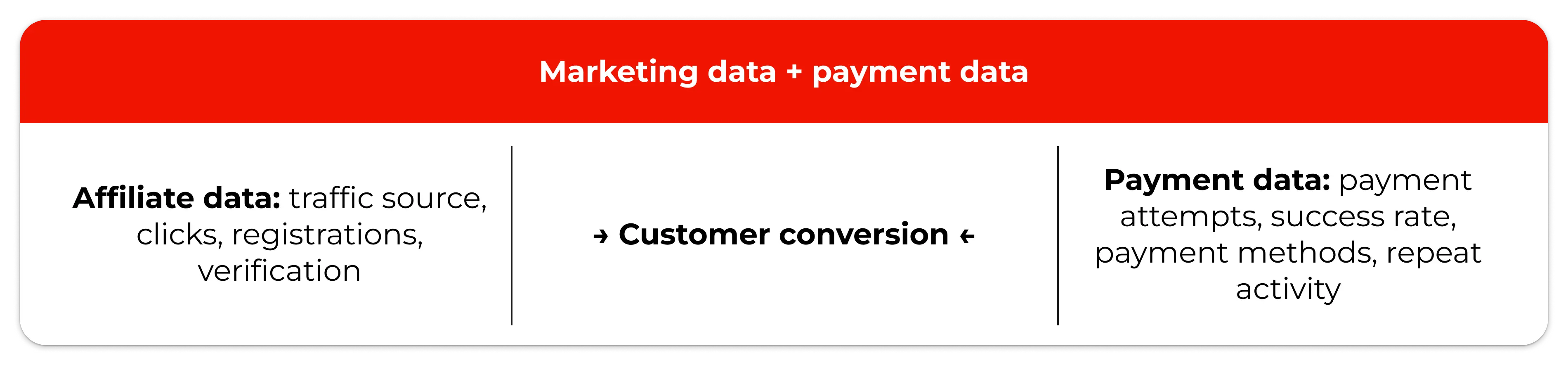
Affiliate partnerships work better when value is measured beyond the lead
From a marketing perspective, measure affiliate value at the cohort level, not the lead level. Two partners can generate the same number of sign-ups and create completely different economics: one may bring users who never complete verification or become active customers, while another consistently delivers customers who convert, retain and generate long-term value.
The strongest affiliate programmes do not stop at leads or registrations. They track whether referred users reach economically meaningful milestones, such as a first-time deposit, funded account or first transaction — and then assess how those users perform over time.
This becomes even more important in regulated and higher-risk verticals, such as trading, Forex, and iGaming, where fraud, compliance, acquisition incentives, and customer quality can materially change campaign economics.
What counts as a meaningful affiliate conversion?
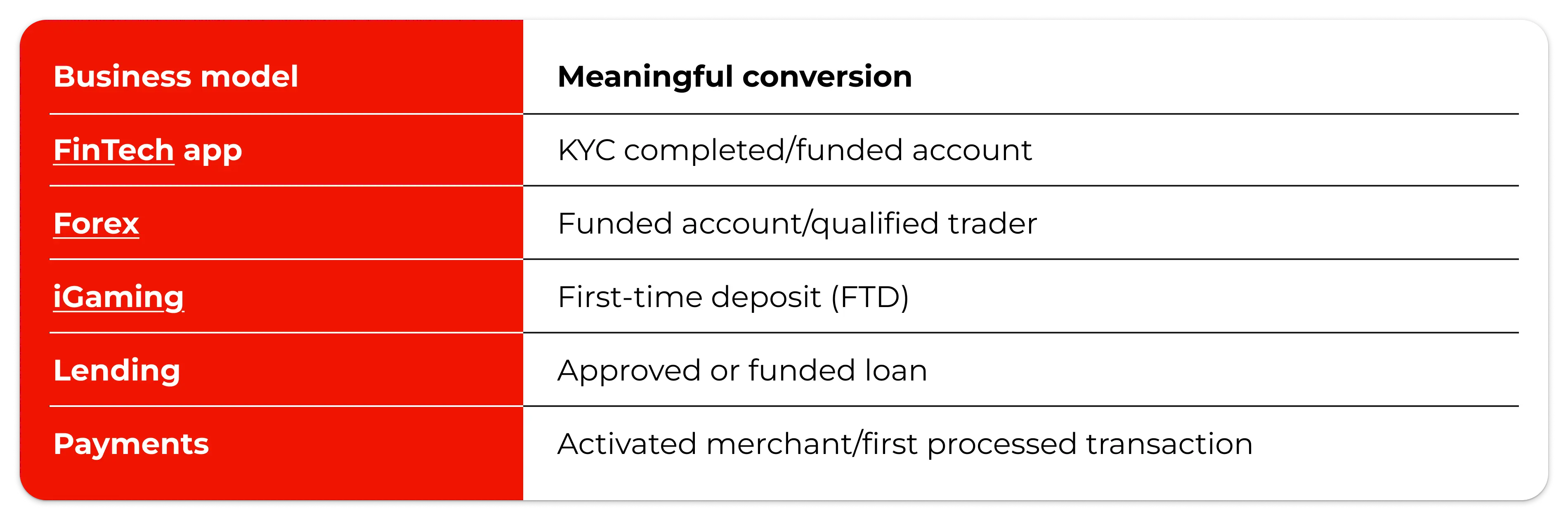
From affiliate click to paying customer
Marketing teams can then spend more on partners that bring valuable customers and identify cases where more traffic isn't the answer. Payment teams can address transaction issues without asking marketers to manage the underlying infrastructure.
For High-Risk merchants, SPAYZ.io handles the payment side through a single integration, local payment methods and its P2P Agent Dashboard. That lets acquisition teams focus on what they own: finding the right partners and bringing the right customers to the platform.
Our managers can share more information about affiliate programs and payment infrastructure. Contact the SPAYZ.io team to learn more.