
India's payment landscape runs largely on local, real-time payment rails. UPI alone processes more than 20 billion transactions a month in 2026. For high-growth merchants, this sets a clear requirement: payment methods need to match how people in India already pay.
UPI is the main consumer-facing option. IMPS payments provide another route for bank transfers and can also support payouts. They differ in adoption, user experience and how merchants use them.
Then there's the operational side. Higher-risk or high-volume traffic needs reliable transaction monitoring, risk-based checks, reconciliation and predictable settlement. A payment method may be available technically and still perform poorly once real traffic starts moving through it.
India’s payment landscape: why local rails matter
India's shift towards digital payments has been fast. UPI now operates at a scale that directly shapes how customers expect to pay. In May 2026, the network processed 23.2 billion transactions worth INR 29.9 trillion, with 720 banks live on UPI. April had already reached 22.35 billion transactions.
UPI is an account-to-account payment system. Customers initiate transfers through supported mobile apps instead of entering card details at a conventional checkout. Payments move through India's domestic infrastructure and can be confirmed in real time. That familiarity affects conversion.
Internal processing data shows that more than 90% of users in India complete transactions on smartphones. Changes to the payment flow have also increased conversion by 23%. Both figures point to the same practical issue: customers expect short, mobile-first flows.
For High-Risk payment processing in India, adding an international payment option doesn't address that behaviour. Merchants need local payment methods in India that customers already know.
UPI: the payment method merchants cannot ignore
UPI payments for merchants fit naturally into existing payment habits in India. A customer pays directly from a bank account through a UPI-enabled app. No international card network is involved, and the transfer happens in real time. The merchant has more to deal with behind the payment page.
Each transfer has to match the right order. The merchant needs the correct payment status. Delayed or failed transactions need a clear review path. And once volumes rise, finance and support teams need enough information to find a transaction without piecing it together manually.
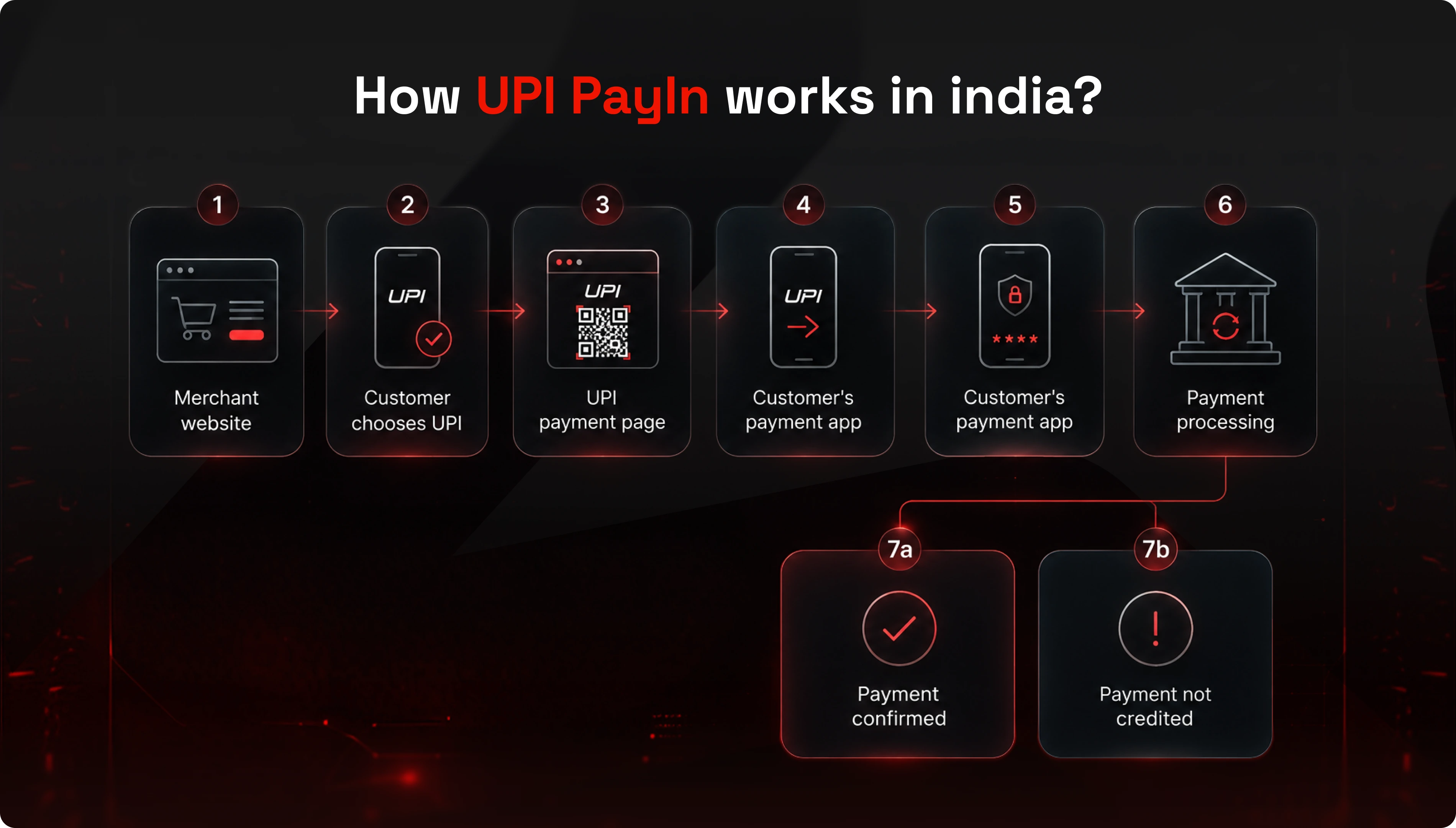
A typical enhanced P2P UPI PayIn flow looks like this:
- The merchant redirects the customer to a UPI payment page with the transfer details.
- The customer sends the funds from their payment app, enters the transaction ID and confirms the payment.
- The transaction is processed and checked.
- Once confirmed, the customer sees the successful payment screen and can return to the merchant's website.
- If the funds aren't credited within the expected time, the customer can upload the payment slip for review.
The last step covers a common edge case. The customer has sent the money, but the system hasn't credited it automatically. Instead of leaving the transaction pending with no clear next step, the flow gives the customer a way to provide proof of payment.
Where IMPS payments still fit
UPI dominates consumer payments, but IMPS still moves a substantial amount of money.
Immediate Payment Service is another real-time system operated by NPCI. In June 2026, it processed 353.92 million transactions worth INR 6.77 trillion across 979 member banks.
The difference becomes clearer at the user level. UPI is deeply embedded in India's mobile payment habits. Current processing data shows lower IMPS volumes and more payment friction. Its screens and flows can be less consistent, giving customers more opportunities to hesitate or abandon the transaction.
IMPS still has a clear use case. It provides another local payin route and can support payout, depending on the provider setup. This matters for businesses that need funds to move both ways.
So UPI vs IMPS isn't a choice between two versions of the same payment method. They can handle different parts of the merchant's payment flow.
UPI vs IMPS for High-Risk merchants
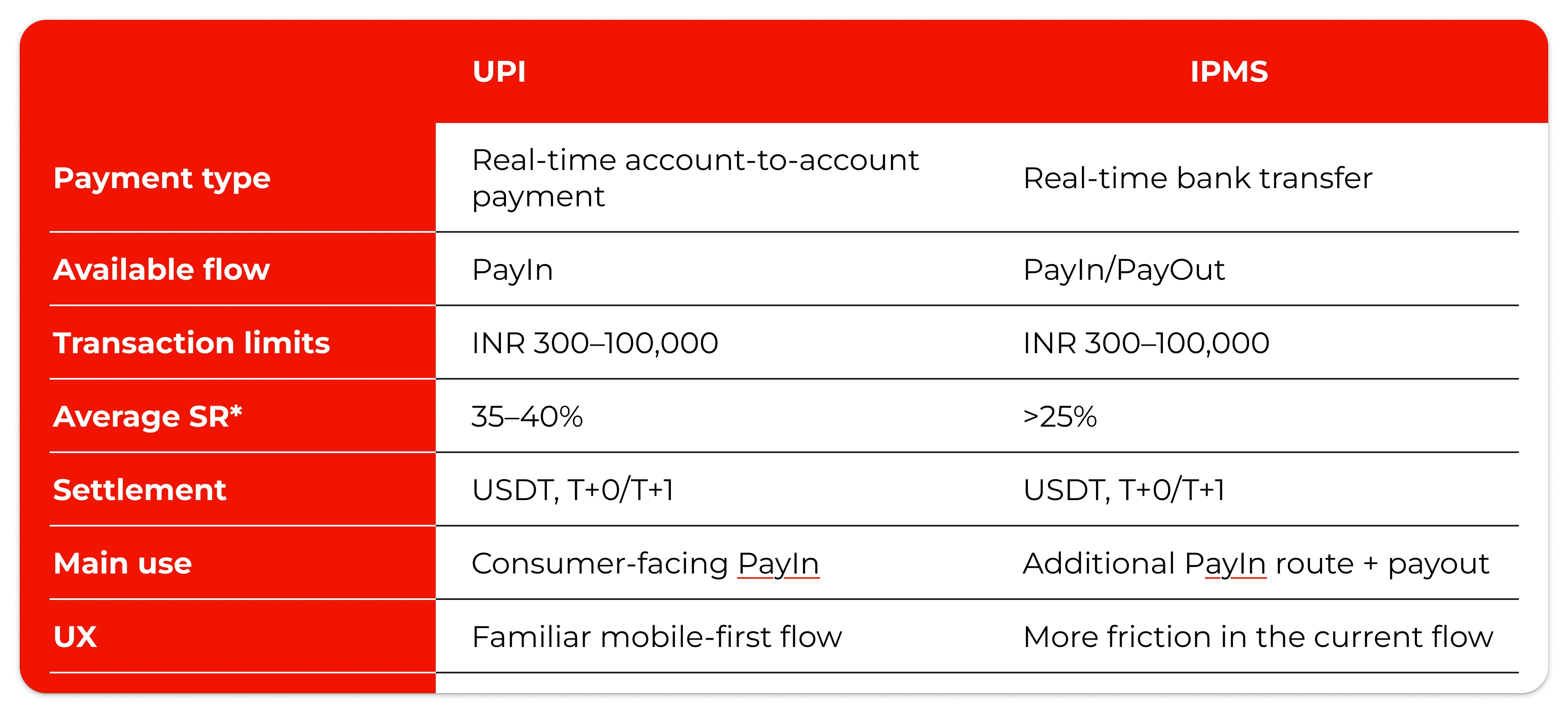
*Average SR based on current SPAYZ.io processing data for India. Results can vary by merchant profile, traffic, and payment conditions.
This is why the number of supported payment methods tells merchants very little on its own. A method can be technically available but generate limited usable traffic. Another may perform better because customers already know the flow and complete it with fewer problems.
Current processing data puts the average UPI success rate at around 35–40%, compared with more than 25% for IMPS. Both currently support transactions between INR 300 and INR 100,000, with USDT settlement on T+0/T+1 terms. Those figures are much more useful when comparing payment solutions for High-Risk merchants than a long list of supported methods.
Why High-Risk payment processing in India is harder
Real-time payments leave less time to catch problems. A transfer can succeed at the bank level while the merchant still sees it as pending. The customer tries again. A duplicate appears. Or support gets a message about a completed payment before the finance team has matched it to the original transaction. And that’s it.
A small operation may be able to resolve these cases manually. At higher volumes, that stops working. High-growth businesses can also face closer checks because of their business model, transaction patterns or customer geography. Banks and payment partners need to understand the traffic they're processing and identify activity that doesn't fit the expected profile.
This makes payment risk management part of day-to-day processing. Merchants need to know how payment status is confirmed, how unusual activity is reviewed, and what happens to transactions that fail to reconcile automatically. Speed creates its own pressure here. Payment fraud in India doesn't slow down because the underlying rail is faster. The controls around it must keep pace.
For an India payment gateway, good transaction records and a clear process for exceptions matter as much as a fast checkout.
Risk-based checks and merchant due diligence
Indian regulation doesn't put every high-growth business into a single merchant category.
RBI's KYC rules use a risk-based approach. Regulated entities assess customers using factors such as their business activity, geography, services used, delivery channels and transaction types. Higher-risk accounts can then receive closer monitoring. That assessment starts before processing.
A payment partner may ask about the business model, expected volumes, transaction patterns, and markets involved. How far the checks go depends on the risk profile. The same information helps later. If the provider knows what normal activity looks like for a merchant, a sudden change in volume or behaviour is easier to spot.
RBI also requires monitoring to reflect the customer's risk category and calls for periodic reviews of that classification. For High-Risk merchants, onboarding is therefore only the first check. Merchant due diligence still matters once transactions start moving.
What High-Risk merchants should check before entering India
A long list of payment methods doesn't tell you how well a provider will handle real traffic. When comparing payment providers in India, ask about the operation behind those methods.
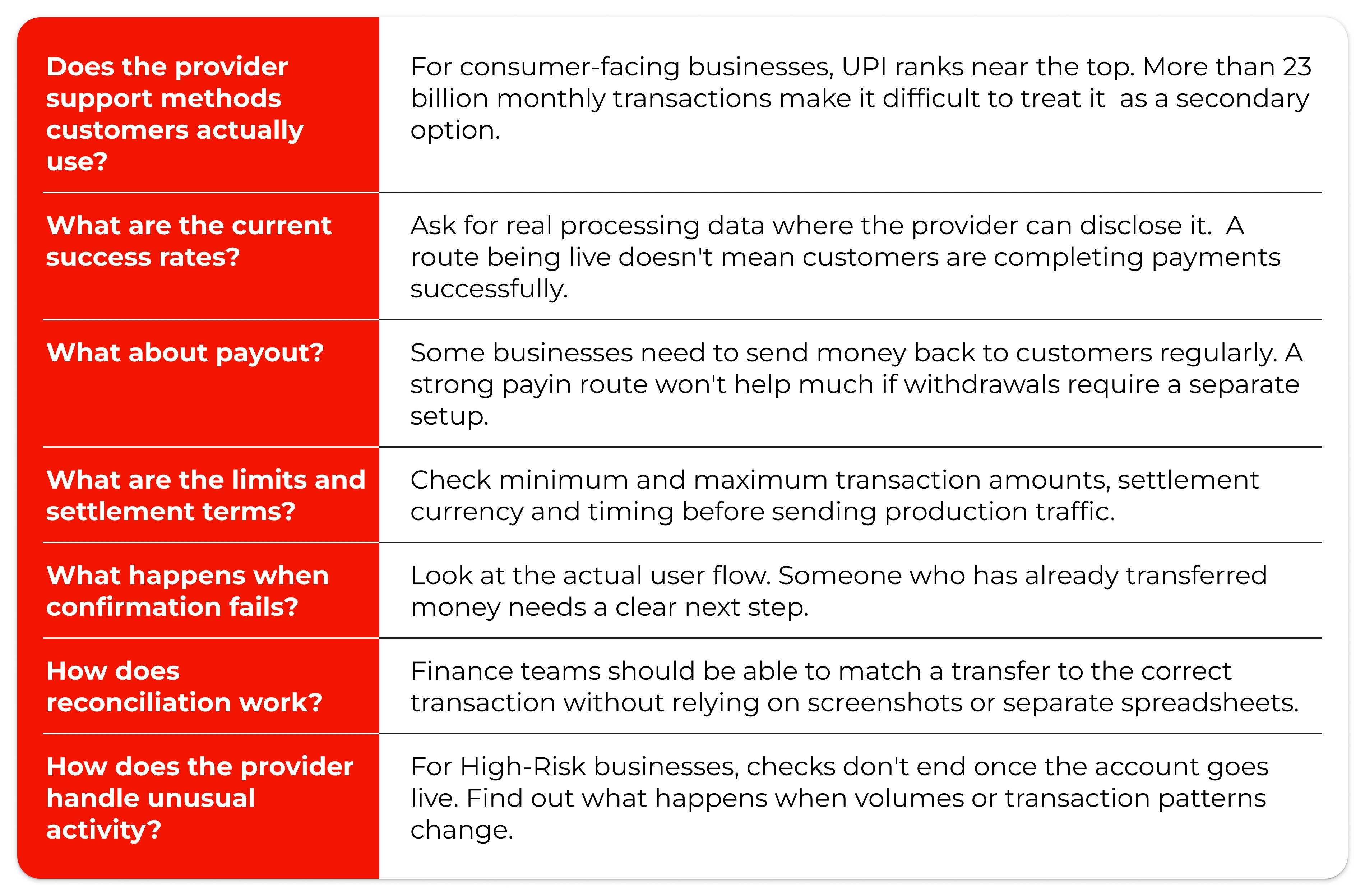
These questions tell you far more than counting payment methods on a provider's website.
A payment setup for High-Risk merchants in India
For higher-risk or high-volume businesses, UPI and IMPS are the customer-facing part of the setup. Behind them, merchants still need transaction monitoring, payment reconciliation, settlement and a way to handle exceptions.
SPAYZ.io provides payment solutions for High-Risk merchants in India through an enhanced P2P payment flow and a single API integration.
The current setup includes:
- UPI PayIn and IMPS PayIn/PayOut in INR;
- transaction limits from INR300 to INR100,000;
- average SR of 35–40% for UPI and above 25% for IMPS;
- USDT settlement on T+0/T+1 terms with no settlement fee;
- a fallback process for payments that aren't credited automatically.
The P2P Agent Dashboard gives payment teams a single interface to monitor transactions and manage P2P operations. Businesses operating in several markets can also connect additional local payment methods through the same API. For merchants looking for a high-risk payment gateway in India or a payment gateway for Forex in India, the setup depends on the traffic itself: expected volumes, transaction sizes, required payin and payout routes and the markets involved.
Looking for a payment provider in India? Talk to our team about UPI and IMPS payment flows for your business.