
Forex payments rarely fail for one reason alone.
Usually, the problem lies in:
- intersection of geography
- payment-method fit
- issuer behaviour
- user trust
- settlement speed
- amount of friction in the checkout flow
In practice, that means: a broker can have strong acquisition, solid retention, and a competitive product, but still lose volume because regional payment performance varies from market to market.
That is exactly why local coverage matters more than generic global acceptance. A payment setup may look broad on paper, but if it does not reflect how users actually pay in a specific country, approval rates by country begin to diverge fast.
Different markets — different issues.
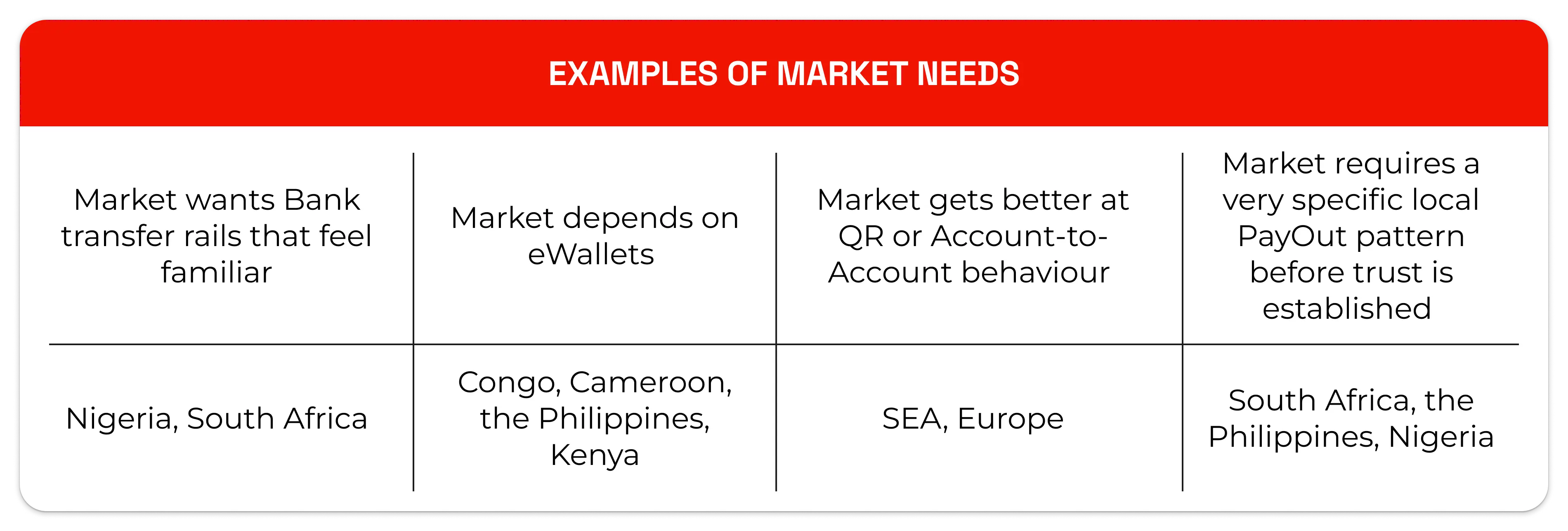
The merchant needs the right methods in the right GEO with the right routing logic behind them.
Why do approval rates by country decide Forex growth
In Forex, approval rates should never be treated as one blended number. One country may convert cleanly, while another underperforms because the payment method is wrong for local user habits, the route is too rigid, or the transaction lands in an issuer environment that does not fit the profile.

The better way to look at performance is country by country, rail by rail, and user context by user context. When payment method, currency, region, and risk profile align, first-try approvals improve.
That difference is especially relevant in Forex because the user journey is sensitive to interruption. A trader who reaches deposit intent and then encounters delay, rejection, or an unfamiliar payment experience does not always come back. A better payment success rate is not only about technical efficiency. It reduces acquisition costs, improves deposit completion, and supports lifetime value by making the first funding event easier to complete.
Regional payment performance is operational, not only commercial
Every failed transaction creates noise: support tickets, payment retries, unclear status checks, manual follow-up, and unnecessary pressure on finance and compliance teams. The more fragmented the GEO mix, the more expensive that friction becomes.
At SPAYZ.io, Forex merchants get more than a list of available payment methods. The operational layer includes:

That visibility changes how a payment team works. Instead of reacting after declines accumulate, teams can identify where conversion slips, where a route underperforms, and where local user behaviour requires a different mix of methods. In High-Risk verticals, this kind of control is not a nice extra; it helps prevent the constant patching of payment issues after they hurt revenue.
Local methods reduce friction where Forex usually loses it
Friction appears when the payment method is unfamiliar, the flow introduces too many steps, the transaction path is not optimised for the user’s market, or settlement and confirmation feel too slow for a product that depends on immediacy.
That is why local payment methods matter so much. SPAYZ supports multiple payment methods, including eWallets, Bank transfers, Mass payouts, and QR code payments, and its routing framework is built on the principle that one rail does not fit all markets.
The same logic applies to expansion. Markets such as Nigeria, Japan, the Philippines, South Africa, and Cameroon all have distinct payment expectations, compliance realities, and trust signals.

Fast settlement matters because trust moves quickly in Forex
Speed has a different weight in Forex than in many other verticals:
— When a user decides to deposit, the delay changes intent.
— When payout processes feel uncertain, trust erodes.
— When internal teams cannot clearly track payment status in real time, operational drag grows.

At SPAYZ, the product stack is clearly shaped around that need for speed and control. Real-time monitoring, direct integration, support for PayIn and PayOut scenarios, and a broad mix of local and alternative methods — make it easier to build payment flows that feel responsive instead of heavy. The result is a Forex setup that can move with the user rather than slow the user down.
This is also where High-Risk specialisation becomes meaningful. Forex businesses do not need a payment infrastructure that treats complexity as an exception case. They need infrastructure designed with fraud pressure, regional variability, method fragmentation, and compliance-aware routing already in mind.
What a stronger Forex payment setup actually looks like
A stronger Forex payment setup is not defined by one feature. It is defined by how several layers work together:
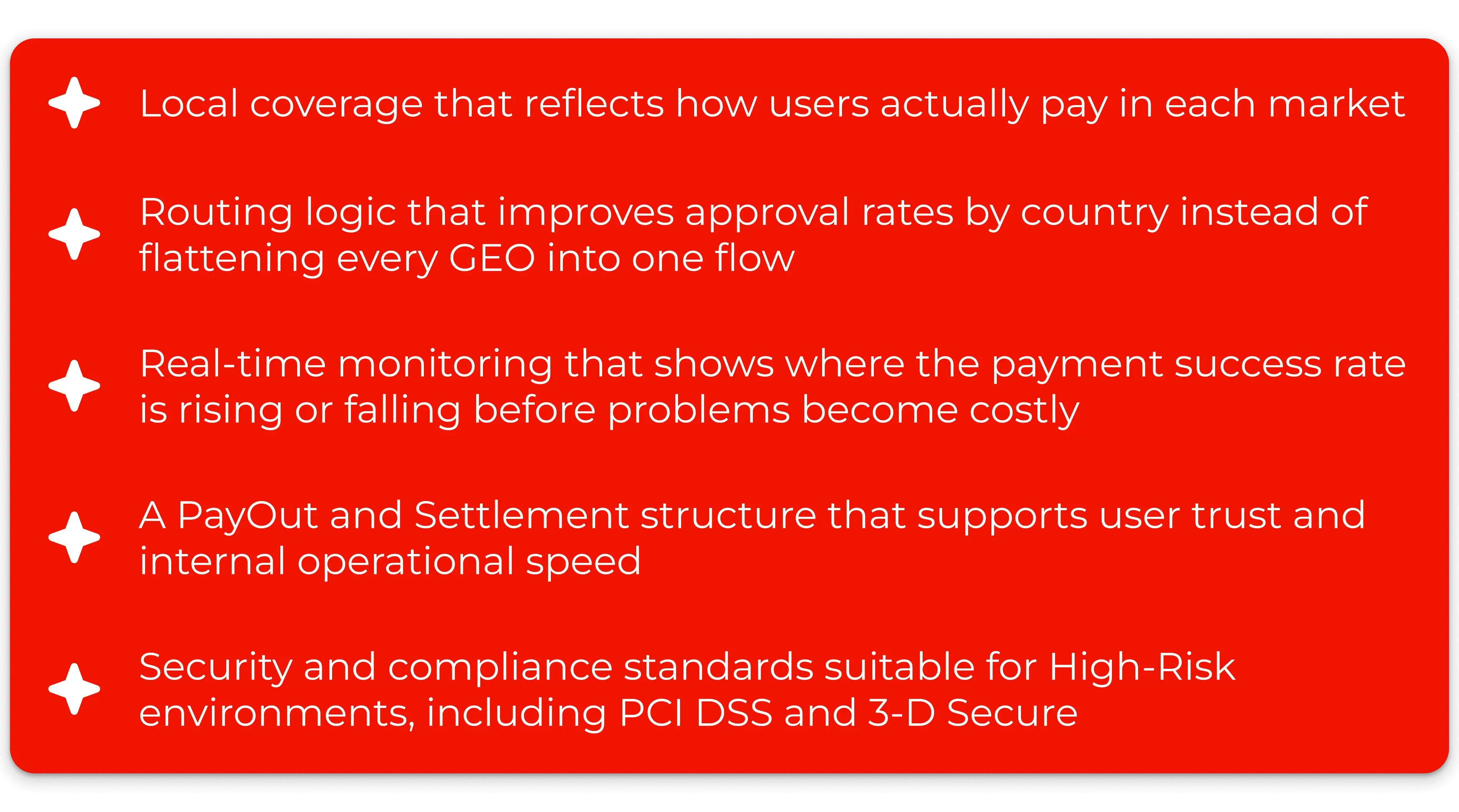
Key thoughts
Forex merchants do not win payments by adding random rails and hoping volume spreads evenly across them. They win by making each region feel local, each transaction path feel intentional, and each settlement flow feel fast enough to preserve user confidence. That is where approval rates by country, payment success rate, and regional payment performance stop being technical metrics and start acting like revenue levers.
Ready to win? Contact the SPAYZ.io manager to scale your business.