South Korea has a well-established digital payment market. People use bank transfers, credit cards and mobile wallets every day. Payments are fast, familiar and closely tied to local banking services.
For international merchants, entering this market isn't quite as simple. A standard South Korea payment gateway might handle transactions, but businesses also need to consider local payment habits, banking requirements and the rules that apply to their industry.
South Korea is now part of SPAYZ.io's growing payment network in Asia. Our South Korea payment solutions include bank transfers, virtual accounts, P2P payments and popular local eWallets, giving merchants access to payment methods familiar to Korean customers.
We've also built flexibility into our South Korea payment infrastructure. By connecting multiple local providers and using our internal auto-routing system, we can manage payment traffic when provider availability or performance changes. This is particularly important in a market with strict regulatory requirements and complex banking arrangements.
For businesses exploring how to accept payments in South Korea, understanding how the local market works is an important starting point.
Key takeaways
- South Korea's payments ecosystem relies on established banking infrastructure, with digital wallets and mobile payment services playing an increasingly important role.
- Local payment methods in South Korea include bank transfers, virtual accounts and P2P models. Their availability depends on the payment provider and the merchant's business.
- SPAYZ.io supports local payment infrastructure in South Korea as part of its broader Asian coverage, including payout capabilities and transaction management tools.
South Korea's payment landscape
South Korea has spent years developing its digital payment infrastructure. Banks offer mobile services, card payments are widely accepted, and platforms such as Kakao Pay, Naver Pay, and Toss have become familiar ways to pay.
The market is still growing. According to the Bank of Korea, the average daily transaction value of simplified payment services increased by 16.8% year on year in the first half of 2026. The value of transactions handled by electronic payment gateway services grew by 12.6% over the same period.
This growth matters because customers are already used to convenient digital payments. They expect to recognise the payment method, complete the transaction without unnecessary steps and receive confirmation. International businesses have to meet those expectations while working within Korea's banking and regulatory systems.
A South Korean payment provider needs to handle more than the transaction itself. Payment confirmation, account verification, reconciliation, and payouts all affect how well the process works.

The challenge becomes greater for merchants operating across several countries. Each market has its own infrastructure, and one payment setup rarely works everywhere. That's why businesses comparing South Korea payment solutions need to look at both local payment coverage and the tools available to manage transactions.
Local payment methods in South Korea
Several payment methods operate in South Korea, from traditional bank transfers to mobile wallets and account-based solutions.
The best payment methods in South Korea depend on the merchant's business model and transaction needs. Businesses that accept customer payments, process withdrawals, or manage P2P agent networks require different payment setups.
At SPAYZ.io, we provide access to South Korea bank transfer payments, South Korea virtual account payments, and P2P payments. These methods form part of our local payment offering, with integration and transaction management handled through our wider infrastructure. The available setup depends on the merchant's business model and payment requirements.
Bank transfers
Bank transfers are widely used in South Korea, allowing customers to send money directly between accounts through online or mobile banking. For merchants, South Korean bank transfer payments offer a way to process transactions without relying on international card networks.
However, businesses still need to track incoming payments, match them to the correct transactions and handle failed transfers. Bank transfers are also important for payouts, particularly for international merchants sending funds to local Korean accounts. Available banking routes, processing times and transaction limits vary by provider and payment arrangement.
Virtual accounts
Virtual accounts are another common part of South Korea's payment infrastructure.
They let businesses assign a bank account number to a customer or transaction. When the customer transfers money to that account, the payment can be identified and matched to the correct record.
The process usually follows four steps:
- The customer chooses a virtual account payment option.
- The payment provider issues an account number and payment details.
- The customer transfers the required amount through their bank.
- The provider confirms the payment and updates its status.
Virtual accounts can be issued for individual transactions or reused, depending on the provider. They help businesses identify incoming transfers and simplify payment reconciliation.
However, account validity, supported banks, transaction limits and confirmation processes can vary. Merchants also need to ensure the provider supports their business category and the required payment flows.
P2P payments
Peer-to-peer payments transfer funds between participating accounts, with payment platforms handling transaction confirmations, records and reconciliation where supported.
For merchants, South Korea P2P payments require accurate tracking, especially when multiple accounts or agents are involved. Teams need to monitor completed and pending transfers, keep balances up to date and resolve payment issues.
These operations must also comply with local banking regulations and the provider's authorised activities, making reliable transaction monitoring essential.
Local eWallets and mobile payments
Kakao Pay, NaverPay, Tosspay, Payco, and Samsung Pay are among South Korea's most widely recognised digital payment services. They let users make payments and transfers through familiar mobile apps, making them a convenient option for everyday transactions.
SPAYZ.io supports all five eWallets as part of our South Korean payment offering. For international merchants, this provides access to familiar local payment options through our infrastructure, without needing to build separate integrations for each supported method.
For merchants exploring South Korean payment methods for online businesses, understanding these preferences is important when choosing which options to offer at checkout. Customers are already familiar with local wallets, but that doesn't mean every service is available to international businesses.
Integration depends on the payment provider's requirements, geographical coverage and supported business categories. The same applies to alternative payment methods in South Korea: merchants need to consider both customer preferences and whether a particular method can support their transactions.
South Korea has a well-established mobile payment ecosystem, with Kakao Pay, Naver Pay, Toss Pay, PAYCO and Samsung Pay among its recognised services. These applications are part of everyday payment activity, allowing users to make transactions through familiar platforms.
What makes South Korea different from other Asian markets?
Asia doesn't have one standard payment system. India, Indonesia, the Philippines and South Korea have all developed their own approaches.
And those differences affect how merchants handle payments.

India has built much of its digital payment activity around UPI. The system connects participating banks and payment applications, allowing users to make account-to-account transfers.
Indonesia has a different model. Its national QR standard, QRIS, allows customers to pay through participating applications using a common QR format.
In the Philippines, wallets such as GCash and Maya are widely used. InstaPay and PESONet provide electronic bank transfers with different processing models.
South Korea combines a developed card market with local banking services, virtual accounts and mobile payment platforms.
For merchants, these aren't just differences in customer preferences. They affect how payments are initiated, confirmed and reconciled.
A payment flow designed around UPI in India won't automatically fit the Korean market. The same goes for an Indonesian QR-based setup.
Regulation is another major difference
Businesses researching South Korea payment regulations for foreign businesses need to consider the country's Electronic Financial Transactions Act and any rules that apply to their activities.
South Korea places strict restrictions on unauthorised online gambling. Financial services and investment-related activities may also require specific permissions. A licence from another jurisdiction doesn't automatically give a business permission to operate in Korea.
For merchants considering High-Risk payment processing in South Korea, the first step is to confirm whether the business and its planned transactions are permitted.
The same applies when choosing a payment gateway in South Korea, especially for Forex brokers. A provider may offer local banking connections, but that doesn't mean every merchant or transaction type is eligible. This is one reason local payment infrastructure needs to be considered alongside compliance, not separately.
How SPAYZ.io built its payment infrastructure in South Korea
SPAYZ.io provides payment solutions for merchants across Asia, Africa and the MENA region, covering 55+ payment methods in over 35 countries through a single API integration. South Korea is one of the markets we've added to our Asian payment network.
We build our payment infrastructure around each market's needs, considering local banking systems, payment preferences, and operational requirements. In South Korea, our offering includes P2P payments, virtual accounts, and bank transfers, with payout currently available for supported payment routes. The exact methods and conditions depend on the merchant's setup.
Working with local payment infrastructure
When a merchant enters a new market, connecting a payment method is only one part of the work. The team also needs to understand how payments are confirmed, which transactions the local banking system can support and how to manage the funds moving through it.
For a South Korean PSP, these details affect service reliability. A business might need to process outgoing transfers to local accounts, identify failed transactions or reconcile payments across several banking channels. Each of those tasks needs a clear process.
SPAYZ.io's broader infrastructure brings available local payment methods and transaction management into one system. That helps merchants work across different markets without managing every part of their payment operations separately.
Keeping payment routes reliable with auto-routing
Building reliable payment infrastructure in South Korea requires more than connecting to a single local provider. Payment routes can become unavailable, and processing performance may change depending on the provider and current operating conditions.
Over the years, SPAYZ.io has built a network of payment providers across Asia. In South Korea, we combine these connections with our internal auto-routing system to manage payment traffic more effectively.
The system works through a routing cascade, where several eligible providers are connected within one payment setup. If a provider becomes unavailable or its transaction success rate drops, auto-routing can redirect traffic to another available, better-performing provider.
This reduces dependence on individual providers and helps maintain payment continuity when local conditions change. For merchants, it also means fewer manual adjustments to payment routes and more consistent control over South Korea payment processing.
One API for multiple markets
Merchants often ask how to integrate South Korean payment methods when they already operate in other Asian countries.
Building a separate technical integration for every market can create more work for development and payment teams. Each provider may have its own API, transaction statuses and reporting requirements.
SPAYZ.io uses a single API integration across its supported payment solutions. This gives merchants one technical connection to manage available payment flows across different GEOs. It doesn't remove local requirements: banks, supported methods, limits, and settlement arrangements still vary by market. But it means businesses don't have to start from scratch each time they expand.
For companies looking for a payment gateway for international merchants in Korea, this distinction matters, because integration is only useful when the underlying payment routes support the business's actual needs.
Keeping track of transactions
Merchants need to know whether a transaction succeeded, failed or is still pending. They also need records that their operations and finance teams can use. This becomes more complicated when businesses work with several markets, banking partners or payment agents.
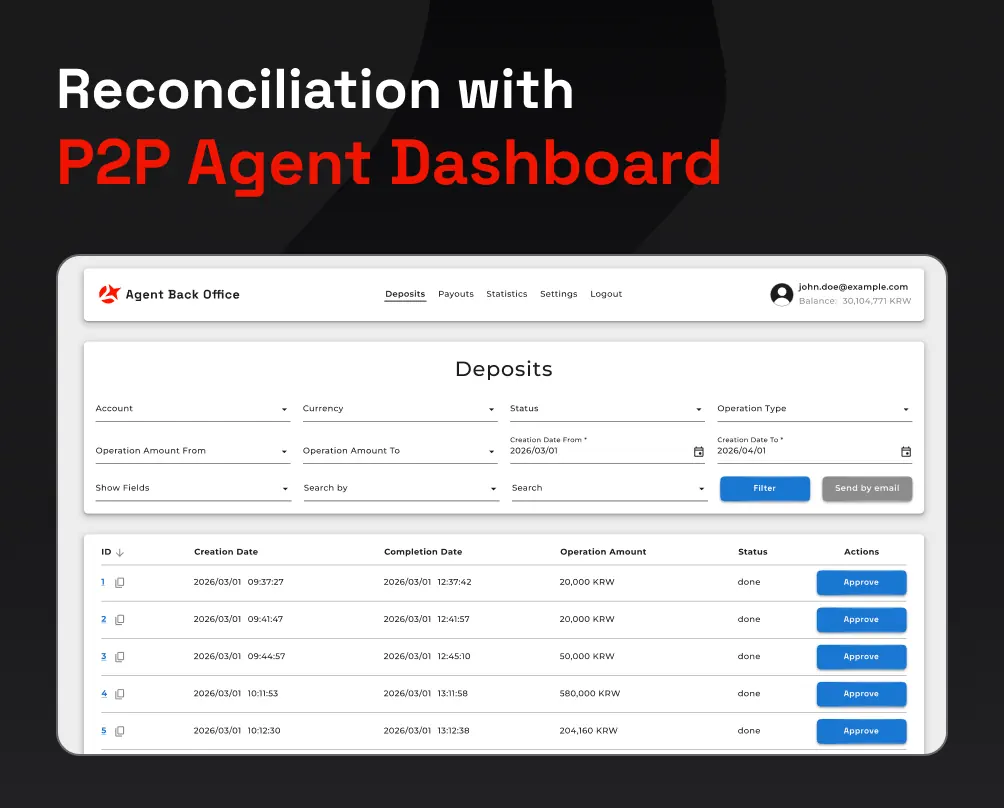
SPAYZ.io provides transaction monitoring and reporting tools that help merchants track payment activity through its P2P Agent Dashboard. The aim is to give teams a clearer view of their operations without relying on separate systems for every market.
For businesses comparing local payment solutions in South Korea, transaction visibility and reconciliation should be part of the decision, alongside payment method availability.
Payment solutions SPAYZ.io offers in South Korea
SPAYZ.io provides a range of local payment solutions in South Korea, including bank transfers, virtual accounts, P2P payments and local eWallets. Merchants can access supported methods through our payment infrastructure with a single API integration and tools to manage transactions across multiple markets.
Our South Korean payment offering includes:

Alongside these methods, SPAYZ.io uses internal auto-routing to distribute transactions across available providers based on their performance and availability. This helps merchants manage changes in payment routes without maintaining separate provider connections themselves.
The exact payment methods, transaction flows, and conditions depend on the merchant's business requirements and approved configuration.
Support for local payment operations
Payment requirements vary across Asian markets, from banking rules and transaction limits to integration conditions. SPAYZ.io helps merchants navigate these differences with support during setup and ongoing operations, making local payment management easier as they expand.
With South Korea now part of our Asian coverage, merchants can manage another market through SPAYZ.io's wider payment infrastructure.
Planning to expand into South Korea? Contact SPAYZ.io to discuss available payment methods, payout options and integration requirements.
FAQ about payments in South Korea
What are the most popular payment methods in South Korea?
Credit and debit cards, bank transfers, virtual accounts and mobile payment services are all part of South Korea's payment market. Kakao Pay, Naver Pay and Toss are among its recognised digital payment platforms.
For businesses, the right choice depends on the payment type, customer preferences and merchant eligibility.
How do virtual account payments work in South Korea?
A virtual account gives a customer an account number they can use to complete a bank transfer. Once the money arrives, the payment provider identifies the transfer and updates the transaction record. This helps the merchant match incoming funds to the correct customer or payment.
Details vary between providers, including account validity, confirmation processes, and whether an account can be reused.
What payment solutions does SPAYZ.io offer in South Korea?
SPAYZ.io supports bank transfers, virtual accounts, P2P payments, and local eWallets, including Kakao Pay, Naver Pay, Toss Pay, PAYCO, and Samsung Pay. Merchants can access supported payment methods through a single API, with transaction monitoring and auto-routing tools to help manage payment operations. Available routes and payment flows depend on the merchant's setup.