A customer makes a deposit. When it fails, they try again, and often there’s the same result.
That alone tells you very little about your payment provider. Maybe the issuer refused the transaction or the customer entered something incorrectly. You can see the real picture change when the same thing keeps happening from one operation to another.
If declines start clustering around one country, method or route, the pattern gives your payment team somewhere to look. And if one route keeps losing approvals while comparable traffic performs normally elsewhere, it may also tell you something about PSP performance.
For merchants using high-growth payment processing, these signals are particularly useful. iGaming payments and Forex payments often run across several markets, each with different banks, user habits, and local rails. A setup can work well in one GEO and struggle in another.
So before changing provider, increasing retries or adjusting risk rules, read the failures properly.
Payment failures are data
A payment decline rate tells you how many payments failed. But it doesn't tell you why.
Suppose your approval rate falls from 88% to 74%. That's enough to flag a problem. Now split the traffic. Bank transfers are still performing normally, and one wallet hasn't changed. But you noticed that a specific P2P route in Indonesia has dropped since Tuesday afternoon.
Now you have something useful.
Good failed payment analysis means breaking failures down far enough to see where the change started. Usually that means looking at GEO, payment method and route. Issuer data can help too when it's available.
Separate first attempts from retries as well. Otherwise, one customer trying the same failed payment four times can distort the headline number.
For the same reason, never read your payment success rate without context. A provider-wide average can look stable while one market is already having problems.
What different decline patterns usually mean
A decline pattern won't always give you a single clear answer. It can, however, narrow the investigation quickly.
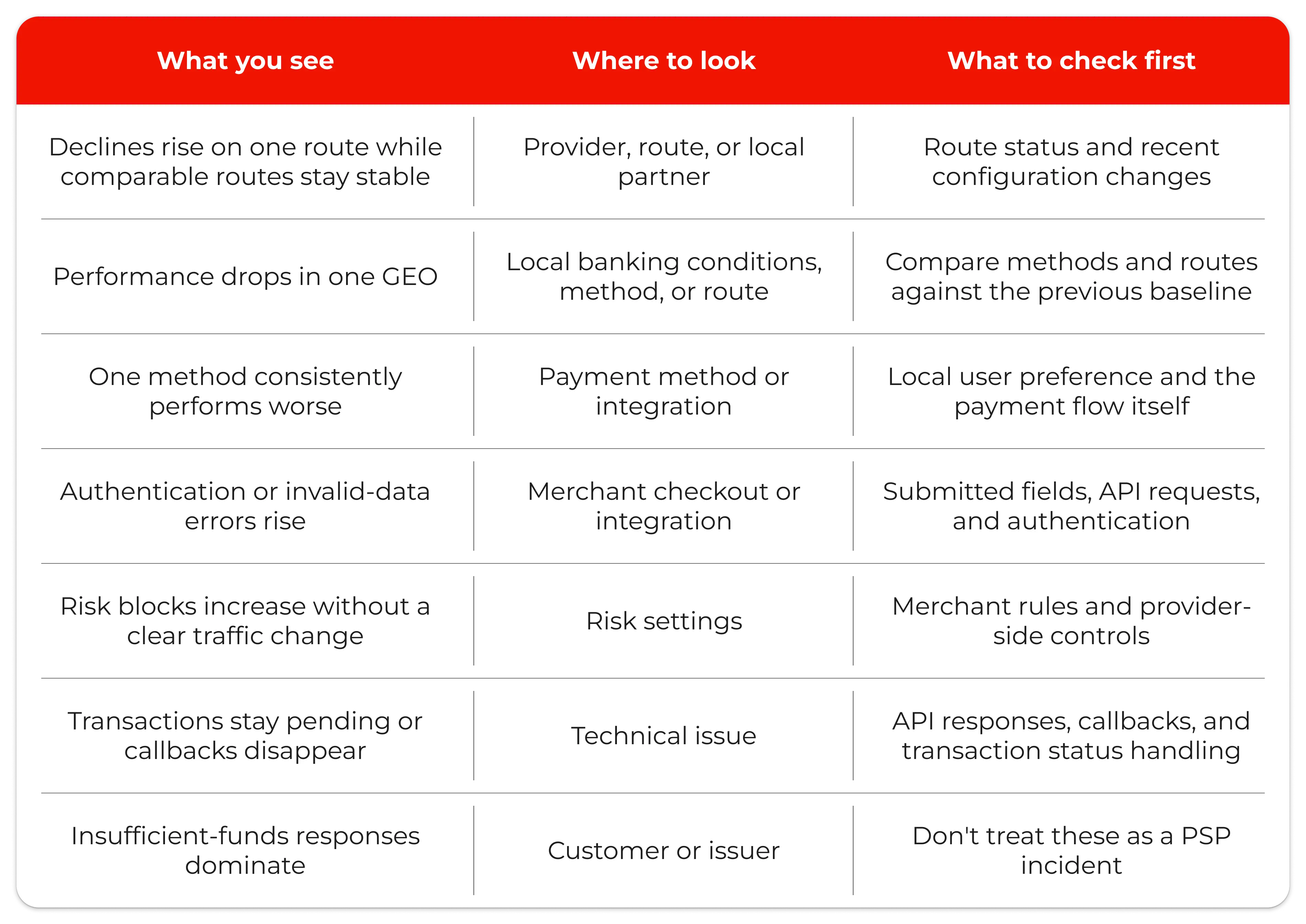
An issuer decline needs a different response than a risk block, and a technical error needs another. In this way, changing checkout UX will not fix an issuer restriction or repair a broken route. The main goal is to isolate the group that started behaving differently, not to find one explanation for all payment failures.
That's where payment decline patterns become useful
Soft decline, hard decline, and technical failure
Not all declined transactions should be treated in the same way. The first distinction is whether the payment can reasonably be attempted again, requires customer action, or failed before normal authorisation could be completed.
That difference affects how the merchant responds and whether another attempt can improve the payment success rate.
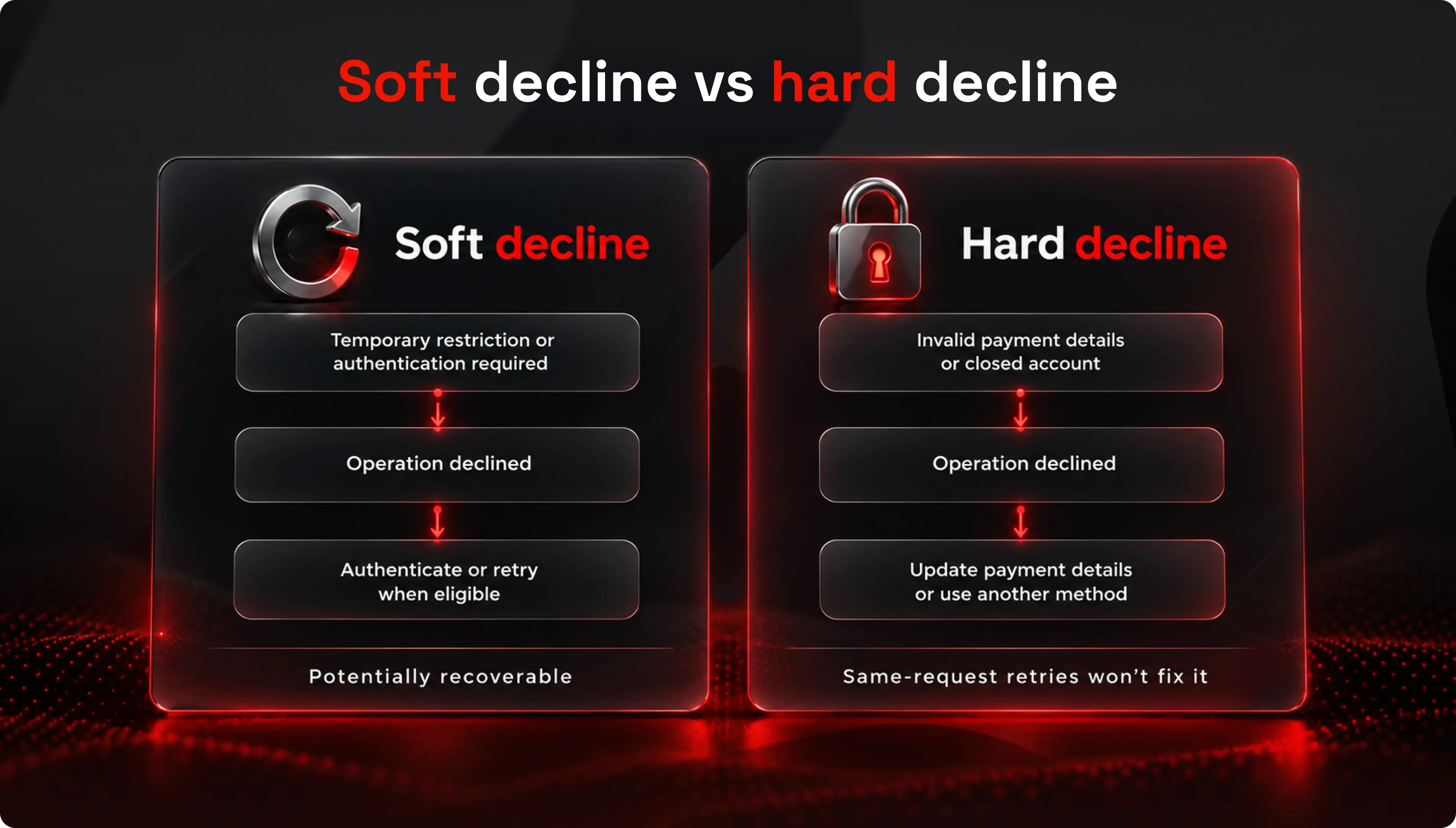
Soft decline
A soft decline happens when the issuer refuses a transaction because of a condition that may change. The payment itself isn't necessarily invalid, so another attempt can sometimes succeed.
For example, the customer may need to complete additional authentication. An issuer can also decline a payment because of a temporary restriction or another condition that doesn't permanently prevent account use. This makes the decline reason important. Retrying immediately through exactly the same flow may produce the same response, while asking the customer to authenticate or waiting before another attempt could resolve the problem.
For merchants, soft declines are therefore potential recovery cases. But they still need rules for when and how to make another attempt.
Hard decline
A hard decline gives the merchant much less room to recover the transaction through another attempt.
It usually points to a condition that won't change simply because the same request is sent again. The payment details may no longer be valid, the account may be closed or restricted, or the issuer may have rejected the transaction in a way that requires action outside the merchant's payment flow; that’s why repeated retries add little value. The customer may need to update their details or choose another payment method.
This distinction also matters when analysing performance. A high share of hard declines caused by customer or issuer conditions shouldn't automatically be read as poor PSP performance. The provider's job is to return enough information for the merchant to recognise what happened and respond correctly.
Technical failure
A technical failure is different because the transaction may not reach normal authorisation. The request might contain missing or invalid data. It can be anything, such as a problem between systems that can interrupt processing before the issuer can approve or decline the payment.
That changes the investigation. If technical failures suddenly increase across one integration or route, asking customers to use another card won't address the cause. Payment teams need to check API responses, transaction statuses, request data and recent integration changes, then determine whether the problem sits on the merchant or provider side.
Repeated technical errors are also useful when assessing a payment provider.
How to handle different payment failures
When payment decline codes help the merchant decide whether another attempt makes sense and what should happen before it, it’s time to build a new payment retry strategy. It should follow the reason behind the failure. A soft decline might allow a later retry or require customer authentication first, but a hard decline may call for a different payment method. The final decision must fit the issue and is an individual option.
When the merchant setup is the problem
For payments in Africa and Asia, poor performance can come from a payment setup that doesn't match local behaviour. Mobile money is widely used across several African markets, while eWallets, QR payments, and domestic bank methods are common across Asia. Supporting a market technically isn't enough if the available local payment methods don't match how customers there prefer to pay.
The setup can also fail at the routing level. Sending most traffic through one route with no workable fallback creates a single point of failure, while payment routing or risk rules built for another GEO can reject otherwise valid transactions. Before treating a rising decline rate as a PSP problem, merchants should check whether traffic is going through the right methods and routes for that market.
When the PSP is the problem
A PSP becomes part of the problem when payment failures are recurring, but the merchant can't identify their source. If the dashboard and API return generic statuses, while support can't distinguish an issuer decline from a risk block or route issue, the merchant has little data to act on. A payment provider won't always know the exact reason for an issuer refusal, but it should make the rest of the transaction flow clear enough to investigate.
Route performance is another signal. If one route consistently falls below its historical payment approval rate while comparable traffic performs normally elsewhere, or the provider has no reliable fallback when that route fails, the issue deserves attention. For iGaming payments and Forex payments, response time matters too: recurring incidents combined with slow or unclear support can turn a temporary processing issue into sustained lost deposits. At that point, weak PSP performance is measurable rather than assumed.
How to control payment failures before changing PSP
Before moving to another provider, check whether you can isolate the problem within the current setup. Otherwise, the same decline pattern may follow the merchant into a new integration.
- Segment the failures.
Break the data down by GEO, payment method and route, adding issuer or transaction size where relevant. This makes it easier to see whether the problem affects the whole setup or one specific part of the traffic. - Separate unique attempts from retries.
Track first attempts independently so repeated transactions don't inflate the payment decline rate. This gives you a cleaner view of actual payment performance. - Compare against your own baseline.
Look at how the same route or method performed before the decline pattern appeared. A merchant's historical data is usually more useful for spotting a change than a provider-wide average built from different traffic. - Monitor and test the affected traffic.
Real-time transaction monitoring can show when performance starts to deteriorate. Move a controlled share of comparable traffic to another route or payment method and check whether the payment approval rate improves. - Review routing before adding more retries.
Smart routing and provider cascading can redirect eligible transactions when the original route isn't suitable, while payment orchestration can manage traffic across several providers. These tools work best when routing decisions follow the actual failure reason rather than automatically sending every decline through another PSP.
FAQ about payment failures and PSP performance
Before changing routing rules or looking for another provider, merchants usually need to answer a few basic questions. These answers help separate normal payment declines from issues that need action.
What payment decline rate should merchants consider normal?
No single payment decline rate works as a benchmark for every merchant. Results vary by market, payment method, issuer, and traffic profile, so your own historical data is usually a better reference point. Compare the same route and traffic type over time, then investigate significant changes rather than judging performance against an unrelated industry average.
How can I tell whether payment failures come from the PSP or my setup?
Start with the payment decline patterns. If failures cluster around one route while comparable traffic performs normally elsewhere, investigate the provider or its local infrastructure. If declines appear after changes to checkout, risk settings or payment routing, check the merchant setup first. The transaction data should help narrow down where the change occurred.
Should every declined payment be retried?
No. The right response depends on the payment decline codes and the failure type. A soft decline may be recoverable after authentication, a delay or another eligible attempt. A hard decline usually requires the customer to take another action or use a different payment method. Investigate technical failures before resending the same transaction through the flow.
When should a merchant consider changing payment provider?
A change becomes worth considering when poor route performance persists after you've ruled out merchant-side issues, or when the PSP cannot provide enough transaction data to identify recurring problems. Limited local payment methods, unreliable fallback options, and consistently slow incident support can also be reasons to review your current setup.
Before migrating, compare the problem routes against your own historical payment approval rate. That gives you a concrete baseline for evaluating another High-Risk payment provider rather than relying on advertised averages.
How SPAYZ.io helps merchants control payment failures
Payment failures are easier to manage when teams can see what is happening to transactions and adjust the payment setup when conditions change.
With SPAYZ.io, merchants can monitor transaction activity through the P2P Agent Dashboard, including statuses and operation history in one interface. Real-time transaction monitoring helps teams spot changes in payment performance earlier and investigate affected traffic, rather than relying on an aggregate decline rate.
For businesses operating across emerging market payments, the other part is having enough flexibility to respond. SPAYZ.io combines local payment options across Africa, Asia, and the MENA with flexible routing and a single API integration, so merchants can use payment flows suited to individual markets without managing each connection separately.
A decline will still happen. The real value is knowing where it happened, recognising when the pattern changes, and having another option when the current setup stops performing as expected. For more information and analytics, contact our managers.