Payments are a fast-paced, multilayered sector responsible for facilitating approximately $82 billion in B2C and C2C intra-day transactions. And this figure is set to grow, fueled by the fast adoption of digital payment methods in emerging markets. Spayz.io outlines the most powerful and effective methods to enhance your payment system.
What is A/B testing in payments?
A/B testing in payments is a method for comparing two versions of a payment flow, interface element, or checkout experience to identify which option improves conversion rates, approval rates, or user experience.
Delivering a tested solution that caters to the needs of merchants and consumers in cross-border solutions is easier said than done. Payment providers have to apply rigorous testing procedures. Add to the fact high competition and evolving customer demands around accessibility and ease of use, and suddenly the creation and rollout of a payment solution is not a simple exercise.
It is a complex approach that SPAYZ.io has firsthand experience with, applying it across different growth plans it is deploying in new jurisdictions around the globe.
A/B testing is simple. It compares two interface options which aim to deliver the same result. For example, a merchant may want to know which user interface will increase the likelihood that a customer completes a payment on their site. By assigning its customers one of several variable interfaces, it can review which ones have the most completed payment transactions and use this information as a basis for a business decision.
Why payment optimisation requires testing
A/B testing allows teams to measure the impact of changes using clear metrics such as conversion rates. As a quantitative method, the sample size is large, and all changes are closely monitored to assess their impact on results and behaviours. In turn, it reduces risk by showing the direct impact of a change, rather than permanently introducing a new change without properly testing its viability. What’s more, there are further efficiency benefits, meaning businesses can gain fast access to business data once a test is completed, while overlapping, parallel tests are being run.
When applying A/B testing in payments, it is important to focus on elements that directly affect user behaviour and payment approval rates. Even small changes in payment flows can significantly impact conversion and transaction success.
Below are some of the first areas payment teams should test.
Payment page layout
The structure of the payment page plays a major role in user trust and completion rates. Testing different layouts can help identify the most intuitive and frictionless experience.
Teams may test:
- placement of the payment form
- visibility of payment method logos
- trust signals and security indicators
- number of fields in the payment form
- positioning of the call-to-action button
Simplifying the layout and reducing visual friction can often improve checkout completion rates.
Payment method order
The order of payment methods can significantly affect conversion, especially in regions where local payment preferences dominate.
Teams may test:
- placing the most popular payment method first
- grouping local payment methods by category
- prioritising mobile wallets in mobile flows
- dynamically adjusting payment options based on GEO or device
Optimising the payment method order helps users quickly select the option they trust and already use.
Mobile checkout steps
In many markets, the majority of payments happen on mobile devices. This makes mobile checkout optimisation a key area for testing.
Teams may test:
- reducing the number of checkout steps
- using autofill for customer data
- minimising redirects between pages
- simplifying input fields on smaller screens
A smoother mobile flow can significantly reduce drop-off during payment.
Verification and redirect flows
Additional verification steps, such as 3-D Secure or bank redirects, can create friction if not implemented carefully.
Useful experiments include:
- embedded verification vs redirect verification
- different timing for authentication steps
- clearer instructions during verification
- progress indicators during redirects
Optimising verification flows can help maintain security requirements while reducing user abandonment.
Localisation by GEO
Payment behaviour varies widely across different markets. Testing localised payment experiences is therefore essential for cross-border payment providers.
Teams may test:
- displaying region-specific payment methods
- local currencies and pricing formats
- translated checkout interfaces
- GEO-based payment method prioritisation
Localised payment flows often improve both payment success rates and overall user experience.
A/B testing in payments is becoming a core tool for improving payment success rates, reducing friction, and optimising the checkout experience across digital and cross-border payment flows.
What is the HADI framework?
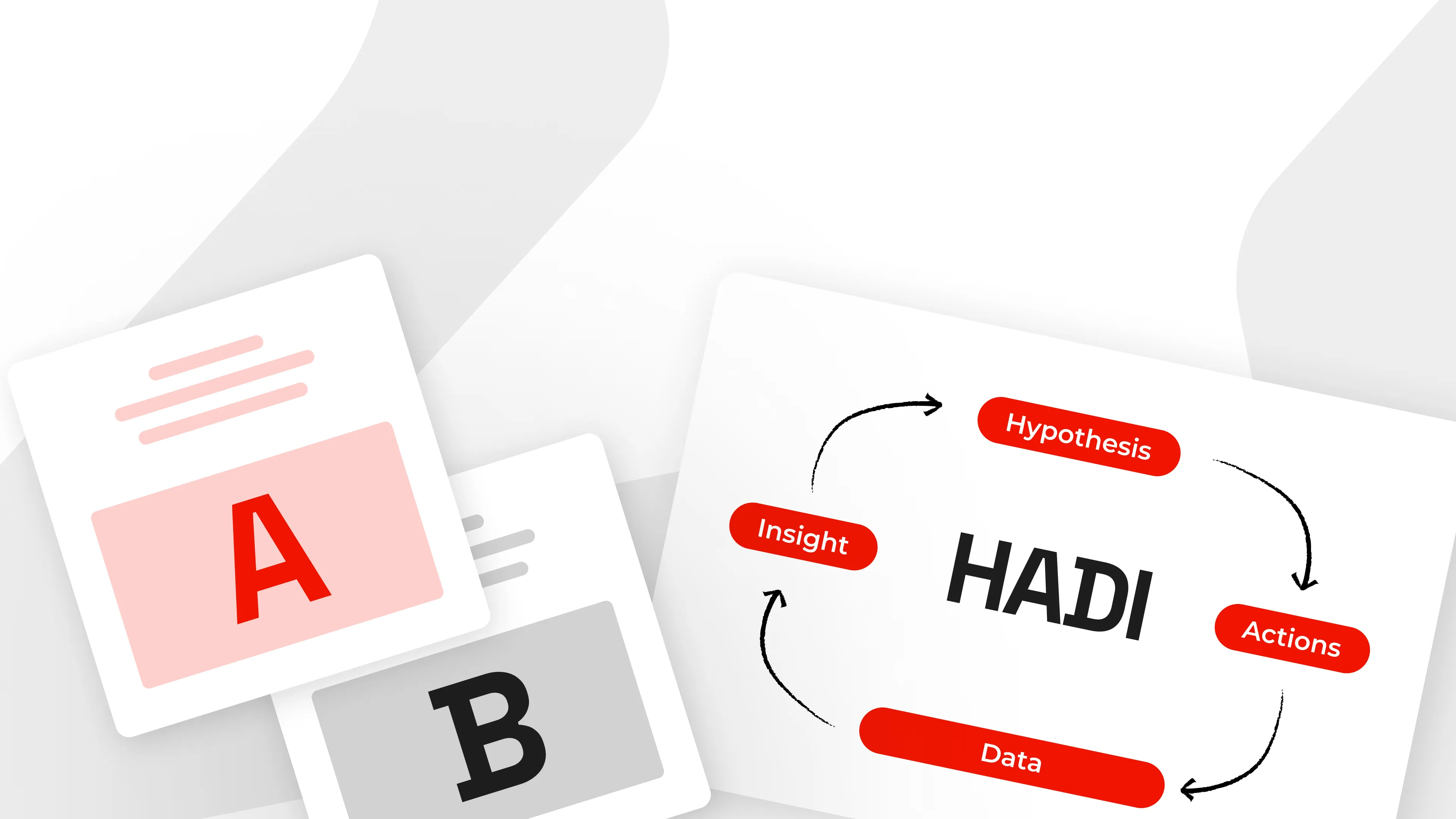
The HADI framework injects the scientific rigour into agile development, turning testing into a structured, data-driven process. It begins with a Hypothesis, a belief about what could improve a process, like streamlining mobile checkouts. Actions follow, with targeted, testable changes. Next comes Data, where performance metrics are gathered. Finally, Insights emerge through analysis, guiding informed, iterative improvements. This is a cyclical process, meaning that after an initial test is completed, the data and analytics gathered can be applied to a more refined round of testing.
H — for Hypothesis
Every experiment begins with a clear hypothesis — a testable assumption about how a change might improve performance.
In payments, hypotheses often focus on improving payment success rates, reducing friction in the checkout flow, or increasing conversion.
Example hypothesis:
Displaying the most popular local payment method at the top of the payment page will increase payment completion rates.
A well-defined hypothesis ensures that experiments are focused and measurable.
A — for Action
The action stage involves implementing the change and launching the experiment.
In practice, this often means running an A/B test, where two versions of a payment flow are shown to different groups of users.
Examples of actions in payment testing include:
- changing the order of payment methods
- simplifying checkout steps
- modifying the payment page layout
- testing different verification flows
The goal is to isolate the variable under test so its impact can be accurately measured.
D — for Data
Once the experiment is running, teams collect data to evaluate its performance.
Key payment metrics typically include:
- payment success rate
- checkout conversion rate
- user drop-off during payment
- time to complete a transaction
Reliable data is critical for understanding whether a change actually improves the payment experience.
I — for Insight
The final step is to extract insight from the experimental results.
Teams analyse the data to determine:
- whether the hypothesis was correct
- how the change affected payment performance
- what adjustments should be made next
These insights help payment teams refine their payment flows and prioritise future experiments.
Why the HADI framework works for payments
Payment systems are complex and influenced by many factors, including user behaviour, regional payment preferences, and technical integrations. The HADI framework provides a repeatable process for testing improvements and making incremental changes based on real performance data.
By continuously running experiments and analysing results, payment providers can gradually improve checkout conversion, payment success rates, and overall payment UX.
How SPAYZ.io uses these methodologies
SPAYZ.io is a rising player in the cross-border payments space and has been applying these new methodologies as part of its expansion strategy.
This approach has led to a smoother, more intuitive journey for users on SPAYZ.io’s dashboard, shaped by data rather than assumptions. By standardising interface design, we’ve significantly sped up the development of our solutions, delivering testable versions faster than ever before. We complement this with our hands-on knowledge and expertise across markets and jurisdictions, providing insights into why certain tests have produced specific results.
Pair that with strict code and design reviews driven by real test data, and the result is a noticeable boost in product quality. All this has resulted in a 23% jump in what we call our ‘success rate’, enabling us to remove minor inconveniences and ensure our clients have access to the best solutions currently available.
Our experience at SPAYZ.io underscores the ultimate importance of this methodology in guiding the future evolution of payments. However, in the fast-moving world of cross-border finance, adopting A/B testing and the HADI cycle requires a mindset shift which challenges legacy thinking and prioritises data-driven business decisions.
In a space where every failed transaction can mean a lost customer, testing isn’t optional. If you’re not testing, you’re guessing. And in this industry, that’s a risk no one can afford to take.