
High-Rsk merchants face payment challenges that differ by market, industry and customer behaviour. Local payment coverage, transaction failures, fraud, fees, and technical integration can all affect whether a payment completes.
What is A/B testing in payments?
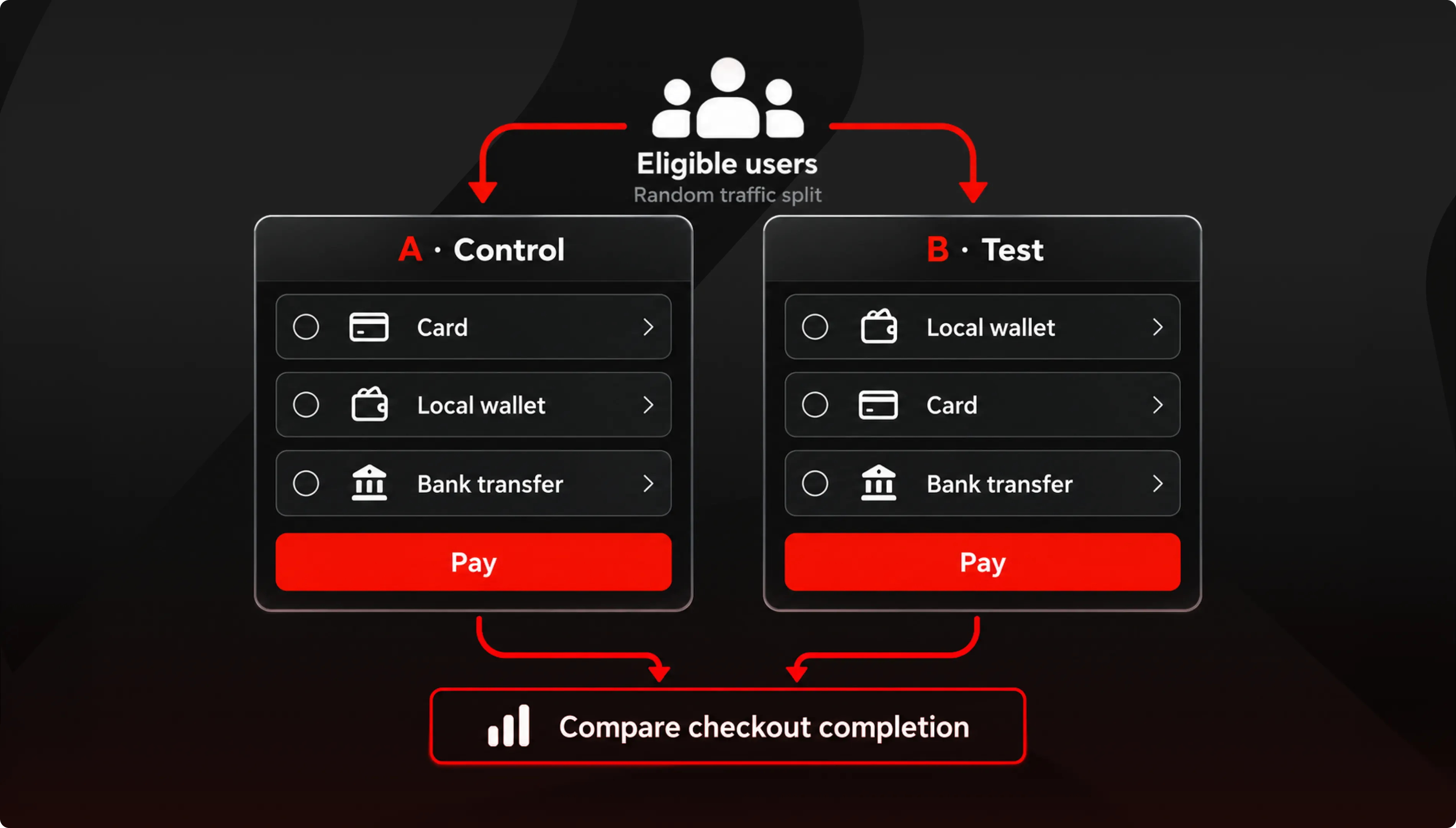
A/B testing in payments compares two versions of a payment flow, checkout interface, or payment configuration to measure their impact on conversion rates, approval rates, or other performance metrics.
Payment teams need to distinguish between checkout conversion and payment approval rates.
Checkout conversion measures how many users complete a purchase or payment flow, while the approval rate measures how many submitted payment attempts are approved. A change to the checkout interface may improve conversion without affecting issuer approvals, so teams should choose their metrics based on what they're testing.
Payment testing can be more complex than testing a standard website feature. Transaction outcomes depend on factors beyond the interface, including payment providers, authentication requirements, local payment methods and customer behaviour. Teams need to account for these differences when designing experiments.
A/B testing compares two interface options which aim to deliver the same result. For example, a merchant could test whether placing a local payment method at the top of the checkout page increases completed payments. One group sees the existing layout, while another sees the revised version. Comparing the results helps the team decide whether to keep the change.
Why payment optimisation requires testing
A/B testing helps payment teams evaluate changes before introducing them to all users. A controlled experiment compares the existing experience with a revised version and uses predefined metrics to assess the results. This reduces reliance on assumptions, but teams still need enough data and a reliable test design before deciding.
When applying A/B testing in payments, focus on elements that directly affect user behaviour and payment approval rates. Even small changes to a payment flow can affect checkout conversion or transaction success rates.
Below are some of the first areas payment teams should test.
Payment page layout
A payment page layout can affect how easily customers find their preferred payment method and complete a transaction.

Removing unnecessary fields or making payment options easier to find may help more customers complete checkout.
Payment method order
The order of payment methods can affect conversion, especially in markets where customers strongly prefer local payment options.
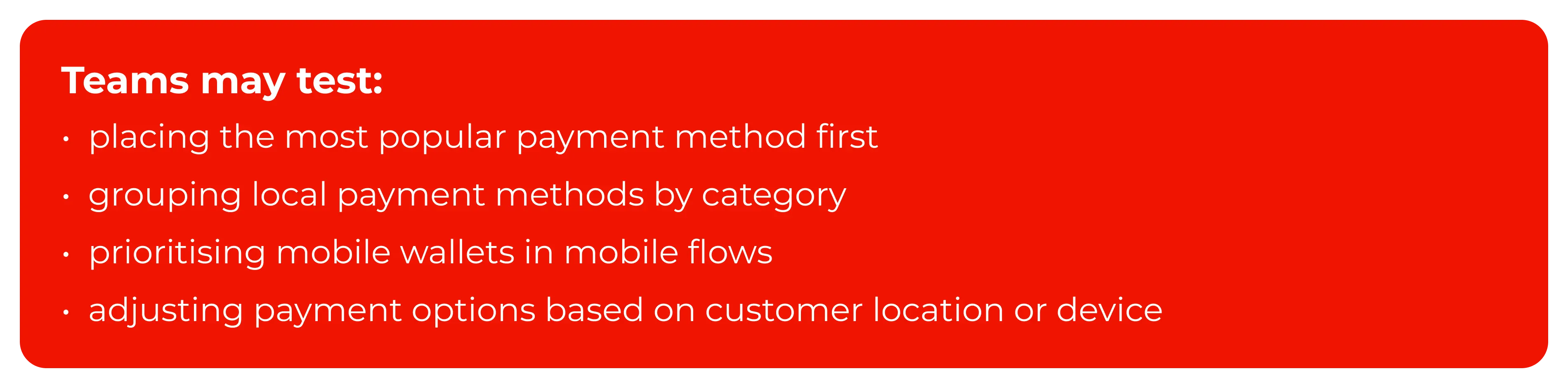
Testing the order of payment methods can show whether placing familiar local options first improves checkout completion.
Mobile checkout steps
Mobile checkout matters in markets where customers rely heavily on smartphones for online purchases.

These tests can help identify which steps cause customers to leave before completing a payment.
Verification and redirect flows
Authentication and bank redirects can interrupt checkout, especially when customers don't get clear instructions.

The aim is to make required verification steps easier to complete without weakening security or compliance controls.
Payment routing
Payment teams can also test how transactions are routed between processors or acquiring banks. For example, they might compare two routing configurations for eligible card transactions in the same market.

These tests should account for transaction mix, fraud exposure, and provider availability. A route that performs better in one market may not produce the same results elsewhere.
Localisation by market
For cross-border merchants, testing local payment methods, currencies, and checkout language can help identify what works in each market.

Localisation can make checkout more familiar to customers, but you should measure its effect on conversion and payment success separately.
How to run a reliable payment A/B test
Before launching a test, define one primary metric and decide what improvement would make the change worthwhile. Split eligible traffic randomly between the control and test versions, and calculate the sample size needed to detect a meaningful difference.
Keep other conditions as consistent as possible and monitor secondary metrics such as fraud, failed payments and processing costs. Once the test is complete, check whether the result is statistically reliable before rolling out the change.
For cross-border payments, it's also useful to review results by country, device and payment method. An improvement in one segment may be offset by weaker performance in another.
What is the HADI framework?
HADI stands for Hypothesis, Action, Data, and Insight. It's a framework for organising experiments and using their results to guide the next decision.
Teams start with a testable hypothesis, make a controlled change, collect relevant data, and review what the results mean. Those findings can then inform another hypothesis, creating a repeatable testing cycle.
In payments, HADI can help teams structure experiments involving checkout design, payment methods, authentication and transaction routing.
H — Hypothesis
Every experiment begins with a clear hypothesis — a testable assumption about how a change might improve performance.
In payments, hypotheses often focus on improving payment success rates, reducing checkout friction, or increasing conversion.

A clear hypothesis gives the experiment a specific question to answer and a measurable outcome.
A — Action
The action stage involves implementing the change and launching the experiment.
In practice, this often means running an A/B test that shows two versions of a payment flow to different user groups.

Where possible, change one variable at a time so the results are easier to interpret.
D — Data
Once the experiment is running, teams collect data to evaluate its performance.

The data should show whether the test met its primary goal without creating problems elsewhere in the payment flow.
I — Insight
The final step is to extract insight from the experimental results.

These insights help payment teams refine their payment flows and prioritise future experiments.
Why the HADI framework works for payments
Payment performance can vary between markets, providers and customer groups. A checkout change that improves conversion in one country may have little effect in another.
HADI gives teams a way to document what they tested, which metrics changed and what they learned. This makes it easier to compare results over time and decide which experiments to repeat, adjust or stop.
For payment providers operating across multiple markets, that record can help you evaluate similar changes in different countries.
How SPAYZ.io applies A/B testing and HADI
SPAYZ.io uses A/B testing and the HADI framework to guide product development and evaluate changes to its P2P Agent Dashboard.
Testing helps the team identify which interface changes make everyday tasks easier for users. Standardised components support faster development and testing of new features, while results from previous experiments inform design and technical decisions.
The team also considers local payment requirements when reviewing results. A change that works well for one market or user group may need a different approach elsewhere.
For merchants and payment providers, testing helps them understand what works before making wider changes. Clear hypotheses, reliable data and regular reviews help teams improve payment processes without relying on assumptions.
Want to learn more about payment optimisation? Contact the SPAYZ.io team to discuss your business needs.