An iGaming PSP used to have a narrow job. Connect the cashier, process deposits and handle withdrawals. Once the setup worked, payments mostly stayed in the back office.
That no longer reflects how operators use iGaming payments.
Paysafe’s 2025 research found that 82% of online sports bettors would stay with a sportsbook after a positive payment experience, while 34% ranked quick and easy payouts as their top factor when choosing where to bet. Its 2026 World Cup research found that 84% were more satisfied when payouts were immediate, while 44% abandoned a bet because their preferred payment method was unavailable.
Payment performance now shows up directly in conversion and retention. It also changes how much work lands with support, finance, and payment teams.
Processing is the baseline
The core PSP functions define whether a provider works at all.
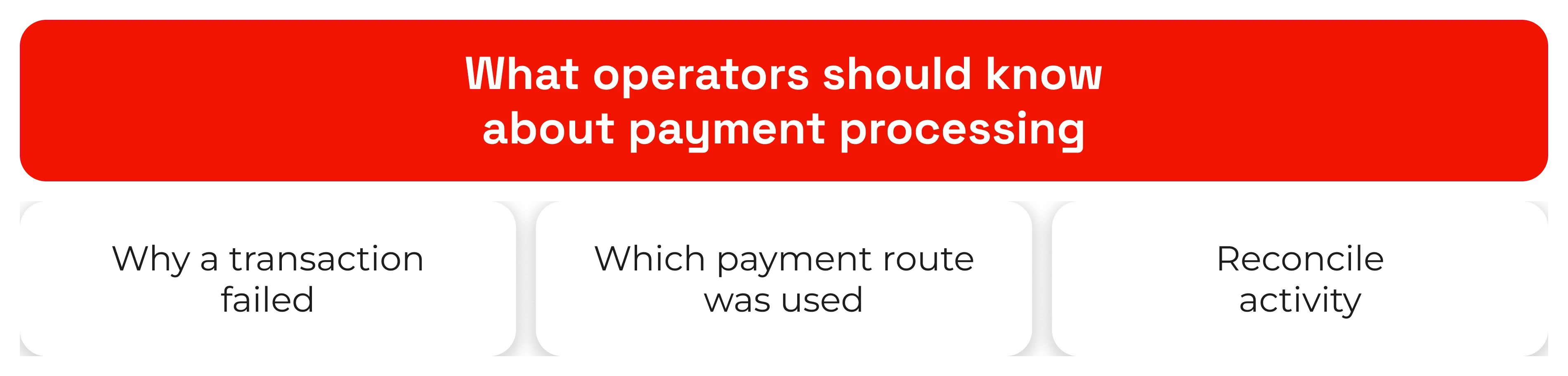
Payment setup now has to cover the full cycle, from iGaming deposits to iGaming payouts. Operators need to know why transactions fail, reconcile activity without rebuilding records by hand, and add payment routes that suit each market. That changes how you assess an iGaming payment provider. Uptime and processing fees still matter, but so do approval rates, payout speed, local coverage, and transaction data that teams can actually use.
This is why iGaming payment processing now directly affects commercial performance. If the payment setup does not match how players in a market actually pay, fewer acquired users become funded players and more of the problem ends up with payment teams.
Payments are part of the player experience
By the time a player reaches the cashier, the intent to deposit is already there, so any friction in the payment flow can turn a ready-to-pay user into an abandoned transaction.
Players do not reset their payment habits when they open an iGaming site. If they normally pay through a wallet, bank app, QR code or mobile service, they are likely to look for the same option at the cashier. That makes iGaming payment methods part of product design. The cashier should match local payment habits instead of asking every player to adapt to the same global mix.
Payout speed now affects retention
Operators have traditionally focused more on payin because deposits hit revenue immediately. Players, however, experience both sides of the transaction.
If a deposit lands in seconds but the withdrawal disappears into a queue, support gets the ticket. Players want to know whether the request has been approved, where the money is and when it will arrive.
A modern iGaming payment provider needs reliable payout routes, clear transaction statuses, and settlement terms that finance teams can plan around. The payment experience continues after the deposit clears.
Regulation also affects how that flow works. In Great Britain, players must be able to withdraw funds from their deposit balance, subject to checks that are strictly necessary to meet wider regulatory obligations. Since 30 September 2026, online operators must also offer gross deposit limits and can use the term “deposit limit” only for limits defined on that basis.
A PSP does not own the operator’s responsible-gambling controls. The payment integration still has to work within them.
Local payment coverage affects whether a new GEO converts
A payment method only matters if people in that market actually use it. In emerging markets, local habits often differ sharply from card-led checkout models: GSMA reported 2.3 billion registered mobile money accounts and $2.1 trillion in transaction value in 2025, while many Asian markets rely heavily on bank transfers, eWallets, and QR payments.

For operators, local payment methods for iGaming can affect both conversion and payout performance, so a payment gateway for iGaming should be assessed market by market. Broad “global coverage” matters less than knowing which methods are live locally and whether they support the payment flows the operator needs.
Fraud controls sit inside payment operations
For High-Risk merchants, fraud monitoring is part of day-to-day payment operations. Teams need enough visibility to spot suspicious patterns while transactions are still running, rather than reconstructing them after the fact.
In September 2026, FATF published new risk indicators for gaming and gambling. These include using multiple accounts or payment methods under different identities, as well as mismatches between customer and payment information.
A High-Risk payment provider therefore needs to show more than a final transaction status. Payment teams need to see how the transaction was routed, where it failed, and whether the same pattern recurs elsewhere.
The PSP now shapes day-to-day payment operations
As operators add GEOs, payment methods and providers, connecting another API is only one part of the job. The harder part is seeing what each route is doing once live traffic starts moving through it.
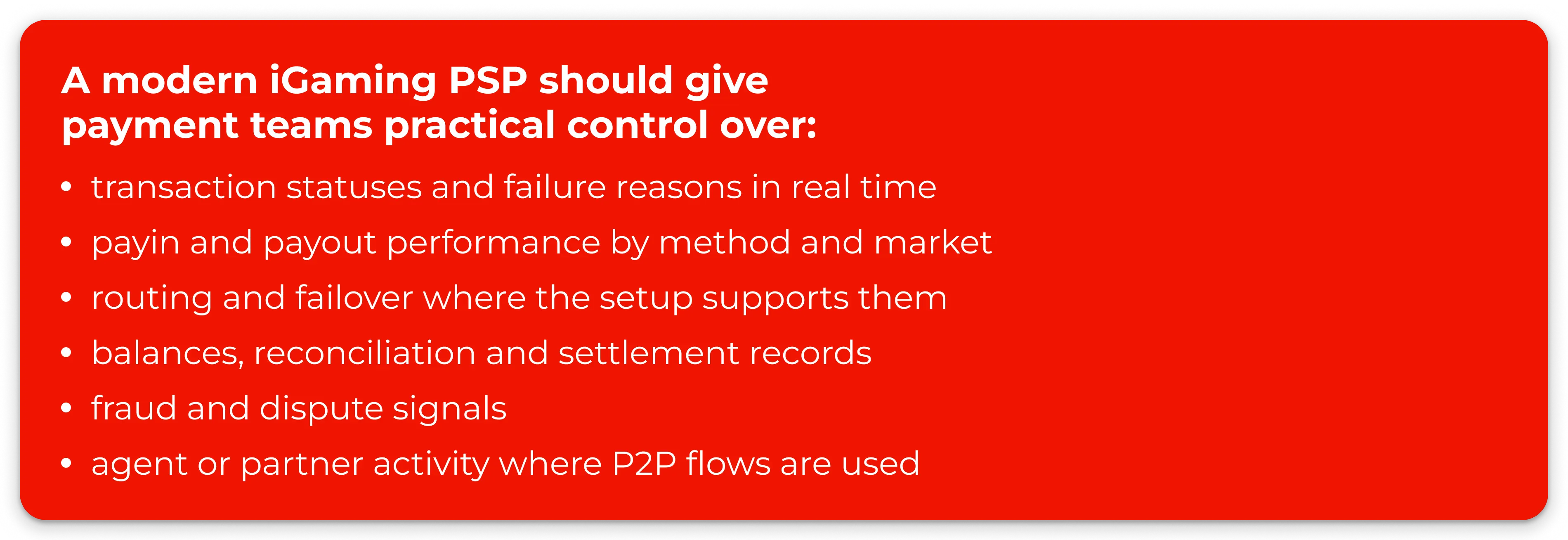
P2P adds another layer. Transactions may involve local agents, commissions, balances and confirmations. Spreadsheets and chat threads become difficult to manage once transaction volume grows.
Payment performance is a revenue metric
Processing cost is easy to compare because it sits on a price sheet. Performance takes more work to assess.
Payment teams need metrics that show where revenue is being lost, or extra work is being created. If deposit success drops in a market, they should be able to trace the issue to a route or payment method; if withdrawals start generating more support contacts, the payment flow should show where the delay occurs.
A payment setup is working when teams can connect transaction behaviour to revenue and operating costs, not just confirm that transactions are being processed.
FAQ about PSP for iGaming
What is a PSP in iGaming?
A PSP connects an iGaming operator to the payment rails used for deposits and withdrawals. Depending on the provider, it may also support local payment methods, routing, settlement, transaction monitoring, reconciliation and fraud controls.
How can payments improve iGaming conversion?
Start by removing avoidable friction at the cashier. Offer methods players already use, match routes to the GEO, and monitor approval rates by method.
Where setup allows, a failed transaction should have a suitable fallback route rather than ending the deposit attempt immediately.
Why are local payment methods important for iGaming growth?
Payment behaviour varies by country. Mobile money may be standard in one market, while bank transfers, eWallets or QR payments dominate another.
Local payment methods let iGaming operators build the cashier around existing habits instead of asking players to change how they pay.
What should an iGaming operator look for in a PSP?
Start with actual coverage in the target GEOs. Then compare payin and payout support, approval rates, settlement terms, reporting and routing options. Fraud controls and the quality of operational support matter once traffic is live.
A provider that can process a method but cannot show what happens when it fails leaves too much investigation and reconciliation with the merchant.
The PSP brief has changed
For iGaming operators, the PSP now affects much more than whether it can process a transaction. Payment performance shapes how effectively acquired players become funded accounts, while local coverage determines whether the same setup can work across different GEOs. As the business expands, payment teams also need enough visibility to manage issues without adding more manual work each time a route or method changes.
That is the point where payment infrastructure starts to affect growth directly. SPAYZ.io works with high-growth merchants across Africa, Asia, and the MENA, combining local payment access with payin and payout support through a single API integration. Its P2P Agent Dashboard adds real-time transaction control for merchants that manage agent-based flows.
If you are entering a new iGaming market or reviewing existing iGaming payment infrastructure, SPAYZ.io can help you assess which payment setup fits that GEO and where the current flow is limiting conversion or creating unnecessary operational work. Just connect with our manager.